My Other Sites

Tuesday, April 15, 2025

Mothman Trans History

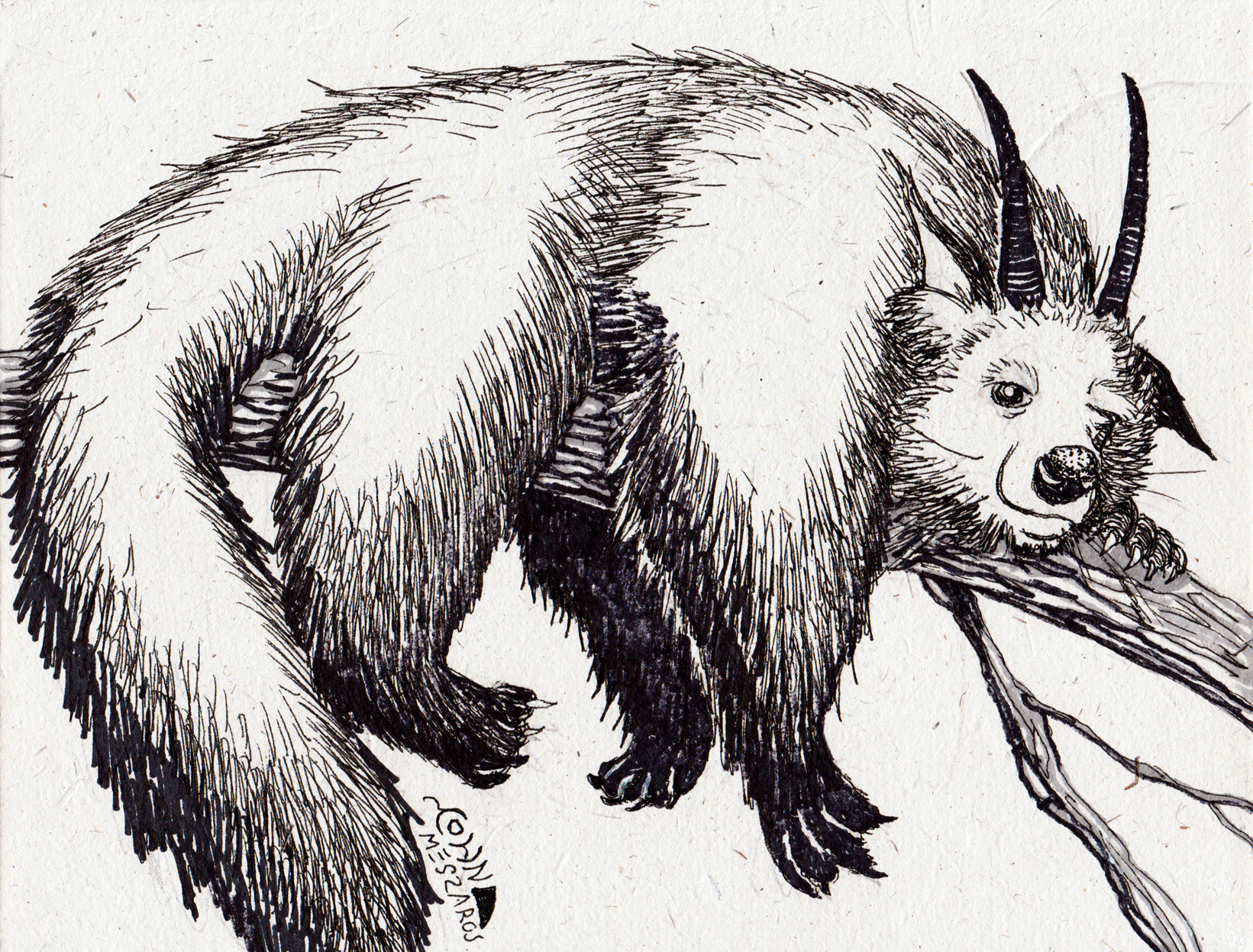
I've been experimenting with using my art more for social and political issues that are important to me.

Cryptids and monsters- especially Mothman- have long been part of queer culture. It’s not hard to see why LGBTQ+ folks would find a connection with creatures that are often misunderstood and feared.

Here I made a flyer with Mothman featuring resources for transgendered and nonbinary history, media and culture.

Here are links to each of these sites in case you have difficulty reading the poster.

https://nyctransoralhistory.org/

recorded narratives from trans folks living in New York City

https://www.transgendermediaportal.org/

an archive of resources for movies and other media by trans and enby creators.

https://www.digitaltransgenderarchive.net/

a collection of papers, articles, and other media on trans people and their lived expeiences.

https://www.pbs.org/independentlens/content/two-spirits_map-html/

a map of cultures with nonbinary gender identities.

https://www.motha.net/

a continuously evolving digital exhibition of trans life and trans experiences.

https://www.nyclgbtsites.org/

sites in New York City with a connection to trans people and trans history.

http://clgbthistory.org/

an association of historians focused on trans, gay, lesbian, bi, nonbinary, and queer history.

https://www.pinktrianglelegacies.org/

an archive of historical documents about queer people interred by Nazi Germany.

Wednesday, April 24, 2024

Roswell Aliens- New Mexico

I always have a bit of a quandary whenever I showcase an alien as a “State Cryptid”. For many people the term “cryptid” typically refers to unknown Earthly animals. But over time this blog has evolved into more of an overall tour of speculative creatures in American pop culture and folklore where the lines between “natural animal”, “supernatural entity”, and “extraterrestrial” become very blurry. I’m also much more interested in the history behind these sightings than the classification of each creature, or even whether it plausibly exists at all. Plus I’ve already featured several extraterrestrials already such as the Pascagoula creatures, the North Dakota Meccano-Mummy, and the Grays that allegedly abducted Barney and Betty Hill.

June 14, 1947- Rancher W.W. “Mac” Brazel and his son were driving on their property 80 miles outside of Roswell, New Mexico when they came upon “a large area of bright wreckage made up of rubber strips, tinfoil, and rather tough paper, and sticks.” What was it? They had no idea.

 Initially unsure about what to do with the strange find, Brazel collected some of the debris a few days later and drove it into Roswell to give to Sheriff George Wilcox. The sheriff, equally perplexed, contacted the nearby Roswell Army Airfield’s 509th Composite Group. They sent a team out to the desert to collect the remaining debris and ascertain what it was. A few days later Major Jesse Marcel made a statement to the local paper about the incident. Though he didn’t explain exactly what the object was, headlines claimed the army had captured a “flying saucer”.

Flying saucers were in the news a lot that year. On June 24th, 1947 amateur pilot Kenneth Arnold reported seeing an airborne, disk-shaped vehicle near Mt. Rainier in Washington. Later, Navy seaman Harold Dahl claimed he had seen a whole group of the strange objects on June 21st near Puget Sound. Soon people were sighting flying saucers everywhere. Much of this hysteria was fueled by fears of the growing power of the Soviet Union and worries about what secret experiments they might be conducting. Paranoia about unknown Russian flying vehicles soon turned upwards beyond the boundaries of Earth as people began to speculate that flying saucers actually came from other worlds. These mysterious objects were labeled UFOs- Unidentified Flying Objects- by the US military and the term quickly caught on in popular culture. Though UFO originally just meant an unknown aerial object, with no indication of origin, it became synonymous with extraterrestrial spacecraft.

Eventually the army explained that the debris found near Roswell had come from a downed weather balloon. But such a prosaic explanation did not stick with the public. The idea that creatures from outer space had crashed on Earth had firmly taken hold, and a good number of people believed that this “weather balloon” story was just a flimsy cover-up. It certainly didn’t help that the government was tight-lipped about many of its programs out of fear that the Soviets might get wind of them.

 It turns out, though, that the weather balloon story was actually close to the truth. In the late 1940s the government began Project MOGUL, in which massive balloons equipped with sensitive detection instrument were launched high into the ionosphere to look for signs that Russia was testing nuclear weapons. One of these balloons had fallen out of the sky, crashed on Brazel’s ranch. Not wanting to reveal their secret project, military officials had felt it was better to let the “alien spacecraft” idea percolate in the popular imagination instead.

A decade later In the 1950s rumors cropped up that people had seen government agents collecting alien bodies in the New Mexico desert. These stories were soon conflated with the Roswell crash legend, leading to conspiracy theories about frozen alien corpses preserved in secret government hangers. For many years any secretive government sight was rumored to have “aliens in the freezers”. Eventually accusations settled on Area 51, a classified military base in the Nevada desert.

 These reports too had a more down-to-Earth explanation, though. Investigations revealed that the “alien bodies” had actually been special crash dummies fitted with sensors and dropped from airplanes by the Airforce to test the effects of high-altitude parachute drops. Like Project MOGUL, these tests had been hidden behind a thick veil of secrecy which did little to dispel the rumors.

As for Area 51, though the government denied its existence for decades despite clear evidence that it existed, it was officially confirmed in 2013 as a base for testing experimental aircraft such as the U2 spy plane, the Archangel-12, the SR-71 Blackbird, and others. No word on frozen alien corpses, though. By the way, the name “Area 51” is more of a pop culture term. The base is typically just called “Groom Lake”, “Homey Airport”, or simply the “Nevada Test and training Range” by the CIA.

The Roswell Aliens story gained a major surge in popularity in the 90s with shows like “The X-Files” and “Dark Skies”, movies like “The Arrival” and “Independence Day”, and comic books like “Roswell, Little Green Man” by Bill Morrison. There was even a 1995 psuedo-documentary called “Alien Autopsy: Fact or Fiction” produced by the Fox Network and hosted by Star Trek actor Jonathon Frakes. It allegedly showed vintage footage of the dissection of an alien corpse from the Roswell crash.  This video was eventually revealed to be a hoax, with the corpse actually a rubber dummy stuffed with jam and animal organs from a butcher.

For my depiction of the Roswell aliens, I wanted to get away from the typical images of corpses lying on dissection tables or floating in preservative-filled tubes. I also wanted to avoid the trope of aliens as malicious, terrifying invaders like in Independence Day or any number of B horror movies.

Instead, I chose to portray them as normal beings adapting to a new life on Earth.   Here we see one of the aliens recovered from their crash with the help of a wheelchair and prosthetics. I’ve imagined them setting up a new life for themselves in New Mexico, just trying to keep to themselves. They’ve taken a keen interest in their new home, evident in their collection of local plants like ocotillo and yucca. They’ve also made friends with many locals, including Indigenous communities, evident here in the “Singing Mother” figure on the table. These figures were first created in 1964 by artist Helen Cordero of the Pueblo de Cochiti, a community of the Keres Pueblo peoples.

As immigrants themselves, the Roswell Aliens also feel a kinship with the many other people that have moved to New Mexico from other countries. This is reflected in the alebrije they got from a Oaxacan-born artist.


REFERENCES

The Roswell UFO Festival!

The Roswell Report: Case Closed

A Smithsonian article on the crashed MOGUL balloon

An article from History.com about the Roswell incident

An article from the Chicago tribune about the high-altitude dummies that were mistaken for alien bodies.

A Space.com article about Area 51

An article about the infamous "Alien Autopsy" pseudo-documentary

Another article about the "Alien Autopsy" film

Thursday, February 8, 2024

The Vermont Monster Guide by Joseph Citro and Stephen R. Bisette


I love monster guidebooks, so when I heard about this tome about cryptids of Vermont, I immediately had to track down a copy.

With its extensive forest, glacier-rounded hills, and deep, dark lakes, it’s not surprising that Vermont is allegedly home to a multitude of strange, unknown beasts. Monster investigator Citro and renowned comic artist Bisette delve deep into the folklore and urban legends of the Green Mountain State to bring these creatures to life with writing and illustrations that are as lurid and sensational as pulpy 19th century newspapers breathlessly relating the horrors menacing backwoods folk.


Some of the featured monsters are familiar- Champ, Bigfoot, the Fur-Bearing Trout.  Others are more obscure, like the trash-eating Pigman, Memphre of cold, glacial Lake Memphremagog, and the Man-Eating Stone of Glastonbury Mountain. There’s also a sizeable pack of creatures known from single encounters, such as Steggy the hump-backed critter, or the “Long-Leggedy Cats” of Burlington.

Bisette has a long history of comic book work, including Saga of the Swamp Thing, and Tyrant, the latter a story about the life of a Tyrannosaurus from the moment of birth. He also co-created the comic character John Constantine. Joseph Citro is a long-time collector of New England oddball stories.  Their guide to things mysterious and monstrous of Vermont is perfect for any fan of cryptids and local legends.  

Though the book is out of print, it's pretty easy to track down good-quality used copies online.

Also, here's an illustration I did of the aforementioned Pigman enjoying a nice breakfast.


Thursday, February 1, 2024

The Shadow Biosphere

A few years ago I wrote an article for Cryptid Culture magazine #7 about the microbial cryptids that may be lurking all around us. Since the magazine has been defunct for a while now, I thought I'd post that article in full here. 

You can still purchase copies of Cryptid Culture from Blurb. Definitely check it out. There were some great articles.


THE SHADOW BIOSPHERE

In our search for unknown creatures we often focus on large, impressive cryptids- Mothman, Sasquatch, the Jersey Devil, Nessie. Beasts that, if they do exist, would be extremely rare and inhabit the periphery of humanity’s territory.

But what if there are uncountable hordes of unidentified organisms all around us? What if they are in the soil beneath our feet? In the damp spots in our basements? Even lurking inside our very bodies? What if there are whole unknown domains of life whose existence we have never even suspected because they are too small to be seen with the naked eye and so radically different from conventional Earthly life that we do not even have the proper tools to detect them? What if there is an entire Shadow Biosphere (a term originally coined by researchers Carol Cleland and Shelley Copley of the University of Colorado in 2005) lurking all around us? 


The exact origin of life on Earth is not currently known, though scientists have posed many possibilities. Some have speculated that life coalesced out of the mineral-rich waters around hot springs or deep-sea hydrothermal vents. Others have wondered if the basic building blocks of life arose in warm tidal pools or on the surface of carbon-based matter floating in droplets of sea spray. Still others have wondered if the components of life might have been brought to Earth on icy comets. It’s possible- even likely- that simple life arose multiple times and in multiple forms in these and many other crucibles on the early Earth. 


At some point, though, one type of life predominated and took over every ecological niche on the planet. This kind of life is highly plastic in the form it takes: bacteria, amoebae, algae, jellyfish, dinosaurs, humans. Organisms very different in form and structure, yet all sharing the same fundamental building blocks. Their genetic information is wrapped up in double-helices of DNA constructed from four bases: guanine, cytosine, adenine and thymine . Their bodies are built and controlled by proteins and enzymes made of 20 different amino acids. And many of their support structures- hair, wood, cell membranes, etc- are constructed from carbohydrates.

But what if other life forms made from different sets of building blocks also developed in those dawn crucibles? What if they used a molecular structure besides DNA to hold genetic information? What if they utilized more than the familiar 20 amino acids to build their proteins? Or a different set of amino acids entirely? Even if such organisms did evolve they must surely have gone extinct early on, out-competed by life that dominates the Earth today? Otherwise we surely would have found evidence of them.

Perhaps not, though. The majority of living things on Earth are prokaryotes- unicellular microbes too small for us to see with the naked eye.  Under a microscope, most prokaryotes look fairly similar. Their cells are either shaped like pills, spheres or twisting corkscrews. You can’t tell what species a prokaryote is just by looking at it.

But this external simplicity and uniformity hides a universe of metabolic diversity. Some prokaryotes can photosynthesize like plants. Some can obtain energy from salt or sulfur. Some live off metals or oil. Some even feed on radioactive materials like uranium.  And of course, there are the more commonly known microbes that parasitize other living organisms. To identify prokaryote species, scientists have developed tools and techniques to detect the various enzymes, chemicals, and other molecular components that allow them to live and feed in these unique ways. Additionally, since prokaryotes are so small and numerous, these techniques are not performed on individual specimens. Instead, they are tested in a “shotgun” fashion on a sample of, say, soil or pond water to detect the overall presence and abundance of certain metabolic components.   These techniques assume, however, that the organisms being examined are composed of the DNA, proteins, and other building blocks of regular terrestrial life.  They would not find denizens of the Shadow Biosphere if their structures and genetic material are different from what we currently know.

There is actually a precedence for discovering a completely new domain of life. Up until the late 1970s all life on Earth was placed into two broad categories based on the structure of their cells. Eukaryote cells have lots of smaller metabolism-performing structures called organelles inside them, including a nucleus to contain DNA, mitochondria to generate energy, and, in the case of plants and algae, chloroplasts to photosynthesize. All animals, plants, algae, fungi, and many single-celled organisms such as diatoms, paramecia, and amoebae are eukaryotes.

The aforementioned prokaryotes, by contrast, have no organelles. Their DNA and all metabolic enzymes float freely in the cell.  For decades all prokaryotes were assumed to be bacteria. In the late 1970s, however, researchers noticed that some prokaryotes had proteins and other chemical structures that were vastly different from those found in the majority of these microbes. What’s more, these strange prokaryotes were genetically closer to each other than they were to any other bacteria. It soon became clear that these organisms were a whole new domain of life that researchers dubbed the Archaea. 

It’s important to note that even though archaea differ from eukaryotes and bacteria in some structural ways, they still utilize DNA and the 20 amino acids found in the other two groups.  Archaea may have evolved separately from the other domains, but they are still ultimately descended from the same distant ancestor as the others. They are not part of a Shadow Biosphere. The point of this story is to illustrate the fact that that unique microbial organisms can indeed be lurking all around us without being detected.

  So, is there any evidence for a Shadow Biosphere? One possible clue to their presence is a phenomenon known as desert varnish. In arid regions around the world, exposed rock outcroppings frequently develop a thin red or black coating of iron, manganese, silica and clay particles. Native peoples around the world have created petroglyph images on these rocks by scrapping away this thin dark patina to expose the lighter rock underneath. Though desert varnish has been extensively studied, its exact origins are not known. Many scientists think it is caused by chemical weathering or by the slow action of bacteria or archaea living on the surface of the rocks. Some, though, have suggested that the dark patinas could have been deposited by the unknown organisms of the Shadow Biosphere. Testing this hypothesis would require developing techniques, which I will discuss a little later, to detect traces of non-traditional life forms.

It’s possible that some of these Earthly aliens have actually been found. In 1996 geologist Phillipa Uwins and her team discovered microscopic filament-like structures on pieces of freshly fractured sandstone they had pulled from 2-3 miles below the ocean floor. Soon, the filaments, which Uwins  dubbed “nanobes”, were found to be growing on equipment and containers in her lab that had come into contact with the samples. Experimentation found that the nanobes would also grow and even multiply on freshly fractured rock samples. Testing with DAPI staining- a technique for finding double stranded nucleic acids like DNA- produced a strong positive result, indicating that these filaments had genetic material and were thus alive.  That revelation created quite a conundrum, though, because these nanobes were one-tenth smaller than even the smallest known bacteria or archaea. At that size, a conventional organism would simply be too small to contain the genetic material and proteins necessary for life. Could nanobes have different chemical structures for carrying out life’s functions? Uwins and her colleagues are still hesitant to definitively claim nanobes are a new form of life, or even alive at all. More research is required to determine the exact nature of these structures.  Nevertheless, they are another tantalizing clue to the existence of an unsuspected Shadow Biosphere lurking all around us. 

All this speculation begs the question: how would one find evidence of the Shadow Biosphere if its denizens cannot be detected by techniques that target known Earth life? One possibility would be to develop experiments that look for other amino acids in the environment beyond the familiar 20. Another possible method would be to develop a chemical reagent that can distinguish between typical DNA and other genetic material that might have different bases besides guanine, cytosine, adenine, and thymine. This reagent could be used to stain a sample of cells gathered from, say, a soil sample. Any cells that were not stained could potentially possess a gene-encoding structure different from typical DNA.

As I stated at the beginning, while the big, bizarre cryptids like Mothman and Thunderbirds may be the most popular, some of the strangest, truly unique organisms on Earth may be lurking under our very feet beyond the limits of what our eyes and scientific instruments can see. The trick to finding them may require looking beyond what we currently understand as life on this planet.   


SELECTED REFERENCES

Cleland, C. E. (2007). Epistemological issues in the study of microbial life: Alternative terran biospheres? Studies in History and Philosophy of Science Part C: Studies in History and Philosophy of Biological and Biomedical Sciences, 38(4), 847-861.

Cleland, C. E., & Copley, S. D. (2005). The possibility of alternative microbial life on Earth. International Journal of Astrobiology, 4(3 & 4), 165-173.

Uwins, P. J. R., Webb, R. I, & Taylor, A. P. (1998). Novel nano-organisms from Australian sandstones. American Mineralogist, 83(11-12, Part 2): 1541-1550.


Tuesday, January 16, 2024

Devil Monkeys- Virginia


Though South America, Central America and southern Mexico have a great diversity of primates, northern North America has none aside from humans. This is ironic given that the earliest known primate- a small, squirrel-like creature called Purgatorius- evolved on this continent.  Descendants of Purgatorius and its relatives diversified into several lineages of tarsier- and lemur-like forms that inhabited North America during the warm Eocene epoch before supposedly dying out as the land grew cooler and grasslands became more abundant.

A fossil find in 1960s altered this view when molars from a lemur-like creature dubbed Ekgmowechasala (Sioux for “Little Cat Man”) were unearthed on the Pine Ridge Indian Reservation in South Dakota. This animal lived in the Oligocene, millions of years after other primates were thought to have died out, proving that at least a few of these lines had continued. Though no younger North American primate fossils have been found since, what if descendants of Ekgmowechasala survived into the present day?

In 1959 a couple by the name of Boyd were driving home near Saltville, Virginia when a strange, monkey-like beast attacked their car. They described it as having light “taffy-colored” fur with a white belly, and powerful, muscular legs. Other people in the Saltville area reported seeing a similar creature around the same time.

Then in the 1990s a woman driving on a dark Virginia backroad saw a creature run in front of her car that she described as black and sleek with a long tail, pointy ears, a short-snouted face, a man-like torso, and powerful hind legs. Though the earlier Boyd cryptid bears little resemblance to this animal- and may in fact have been a different species- both incidents have been conflated in pop culture as encounters with what have come to be called devil monkeys.   

While the Virginia encounters are the most well-known sightings, devil monkeys have been seen throughout North America.  Coweta County, Georgia, for example, is haunted by the Belt Road Booger, a simian creature with a “flat, beaver-like tail covered in hair”. Run-ins with the Booger began in the 1970s, many of them now believed to have been hoaxes by pranksters dressed in gorilla costumes. But other encounters have not yet been fully explained. The Belt Road Booger has become such a local sensation that a taxidermist in Newnan, Georgia even made a fake “Booger” head out of a white-tailed deer’s posterior as a decoration for a friend’s hardware store.

There is also possible photographic evidence of a devil monkey. In 1996 photos surfaced online of a strange, furry, baboon-like carcass lying along the curb of a Louisiana highway. Dubbed the Deridder Roadkill, the body bears a distinct resemblance to descriptions of these cryptids with its long snout, bushy-haired body, and ape-like feet. While some have suggested the carcass was a devil monkey, others have proposed that it could be a rougarou, dogman, or even a chupacabra. More mundane suggestions include a large Pomeranian dog, or even a prop. However, as so often happens in these cases, the body disappeared before samples could be taken, so its identity could not be proved definitively.

Devil monkeys are often said to have powerful kangaroo-like hind legs that allow them to jump huge distances. This feature has led some cryptozoologists to wonder if widely reported “phantom kangaroos” sighted throughout the US and Canada might actually be these animals.

While stories of large non-human North American primates like sasquatch and skunk apes are abundant in folklore and cryptozoology, no fossil evidence for these creatures has been found. Thus if they are real, one could argue that they likely migrated to this continent late in geological history along the same routes that humans used. Devil monkeys, on the other hand, may represent a species of home-grown North American primate possibly descended from Ekgmowechasala or similar animals.


REFERENCES

Eons. (20, November 12). What happened to primates in North America? [Video]. PBS.org. https://www.pbs.org/video/the-first-and-last-north-american-primates-dztigm/#:~:text=Why%20don't%20we%20have,and%20eventually%20they%20all%20disappeared.

Gilly, Steve. (2018, April 20). The Devil Monkey. MountainLore. https://mountainlore.net/2018/04/20/the-devil-monkey/

Grundhauser, Eric. (2016, December 22). Does America have a secret kangaroo population? Atlas Obscura. https://www.atlasobscura.com/articles/does-america-have-a-secret-kangaroo-population

Leftwich, Rebecca. (2023, October 30). Who put the “boo” in the Belt Road Booger? The Newnan Times-Herald. https://www.times-herald.com/news/who-put-the-boo-in-the-belt-road-booger/article_ee9d689e-770f-11ee-a003-8bb851ca9cb4.html

Lynch, Brendan M. (2023, November 6). Fossils tell tale of last primate to inhabit North America before humans. University of Kansas. https://news.ku.edu/2023/11/06/fossil-evidence-tells-tale-last-primate-inhabit-north-america-humans#:~:text=The%20first%20primates%20came%20to,about%2034%20million%20years%20ago.

Morphy, Rob. (2010, January 13). Deridder Roadkill: (Louisiana, USA). Cryptopia. https://www.cryptopia.us/site/2010/01/deridder-roadkill-louisiana-usa/

Morphy, Rob. (2010, December 6). Devil monkeys: (North America). Cryptopia. https://www.cryptopia.us/site/2010/12/devil-monkeys-north-america/

Spooky Appalachia. (2023, April 26). The story of the Virginia devil monkey. [Video]. YouTube. https://www.youtube.com/watch?v=Nsv-mBSEX74

Taylor, Jr. L. B. (2012). Monsters of Virginia. Stackpole Books.


Saturday, May 6, 2023

Ozark Howler- Arkansas


The Ozarks are a range of low mountains found primarily in Northern Arkansas and southern Missouri with portions extending into Oklahoma and Kansas.   Their origins lie in the late Paleozoic when sand, silt, coral, and shells built up as layers of sludge on the bottom of a sea that covered what would eventually become the American South. Over time these sediments hardened into rock- sand became sandstone, silt became slate, and the shells and coral became limestone- and the movement of tectonic plates pushed them upwards into a low dome-like plateau.  Over the next 485 million years rivers and rain gradually eroded the soft rocks into canyons, cliffs, and caves that have provided habitat for bears, bobcats, otters and other Southern wildlife along with more unusual creatures like blind cave fish, collared lizards and endangered grey bats. And perhaps a cryptid or two.

According to legend, the people of the Ozarks have been haunted for decades by the unearthly screams of a beast dubbed the Black Howler.  Those who have caught a glimpse of the monster describe it as a dark-furred cat nearly the size of a bear. Other reports claim it has glowing red eyes and demonic horns sprouting from its head.

Explanations for the beast range from a normal, though unknown, species of large cat to something more supernatural. A few people have even compared the beast to English and Welsh legends of black dogs, cŵn annwn, hellhounds, and other supernatural beasts that bring misfortune to those who see them.

More skeptical people have speculated that the Howler is simply a misidentified cougar. Though these big cats are believed to be extinct in this region, it’s possible that a small population has survived. Or perhaps a few lone individuals have wandered in from other areas. This theory is bolstered by photos from trail cams showing creatures that strongly resemble these animals, and by similar cases of “phantom big cats” occurring in areas of the US where they are not normally found.

Though some claim that legends of the Howler go back generations, cryptozoologist Loren Coleman has found that the first reports of the beast originated from posts on online forums in the late 1990s. His investigations indicate that the “folklore” about the beast was a deliberate hoax to mock the widespread reports of chupacabras and bigfoots that were becoming increasingly widespread at the time thanks to the advent of the internet. Hoax it may be, but the Howler has since become a popular piece of Ozark folklore and sightings are still regularly reported.

 The Howler is especially significant as one of the first urban legend monsters to be created online, laying the groundwork for later, more famous internet creatures like Slenderman, The Rake, Momo, and Trevor Henderson’s Sirenhead.

REFERENCES

An article from Unlock the Ozarks about the Howler

An article from Only in Arkansas about the Howler

An article from Explore Southern History

Loren Coleman's article debunking the Howler hoax

A recent photo of the Howler debunked as a hoax

Wednesday, November 23, 2022

Falls City Metal-Winged Demon- Nebraska


 On a late evening in 1956 “Mr. Hanks” (a pseudonym used by the witness to protect his identity) was traveling down a rural lane near Falls City, Nebraska when a being out of a hypnogogic hallucination sailed over his head. The creature, so Mr. Hanks claimed, was held aloft by fifteen-foot-long metallic wings covered in multicolored lights. These wings remained rigid, yet the being appeared to somehow be guiding its flight with a control panel strapped to its chest. One might naturally conclude that this apparition was just some eccentric human inventor testing a new glider. But then what does one make of Mr. Hank’s description of the entity’s twisted, leathery demonic face and nine-foot height? Though the encounter was brief- the entity flew overhead and disappeared into the dusk in only a few seconds- it would leave Mr. Hanks deeply shaken.

This was not the first recorded encounter with strange, technology-assisted flying humanoids in modern times.  In 1948 Bernice Zaikowski from Chehalis, Washington also claimed to have witnessed a man gliding above her house on a pair of giant, unmoving metallic wings. That same year, several people in Longview Washington reported three men in “flying suits” sailing through the air with the aid of unseen motorized equipment.

Going even further back to 1880, visitors to New York’s Coney Island witnessed a man with “bat’s wings and improved frog’s legs” and a “cruel and determined expression” sailing over the amusement park.

What could these bizarre, mechanically-assisted flying humanoids be? Perhaps, as some have suggested, they were aeronaut inventors testing out novel glider technology. The idea is not unprecedented. In the late 1800s German engineer Otto Lilienthal made extensive studies on the physics of wings (his data served as inspiration for the earliest test flights of the Wright brothers) and even built several gliders that he personally flew. Follow-ups on the Chehalis sighting strongly suggest that what Ms. Zaikowski saw was just such a man in a hang glider.


But then what about the demonic face and massive nine-foot height of the Falls River creature? Was it a mask? Or maybe Mr. Hank was simply misinterpreting what he saw in a panic. If one wants to take a supernatural approach, perhaps these metal-winged creatures were another iteration of otherworldly winged cryptids such as the Mothman, the Cornish Owlman, and the Van Meter Visitor. Supernatural investigator John Keel suggested that cryptids and other strange phenomena such as UFOs, bigfoot, ghosts, etc. might be manifestations of ultraterrestrials- beings from higher dimensions beyond the four we know. According to Keel, humans cannot fully process the true appearance of these hyper-dimensional beings, so our minds piece together approximations that we can comprehend. Maybe Mr. Hank and the tourists at Coney Island got brief glimpses at beings from the other world that had cloaked themselves in forms mortal minds could process.


SOURCES:

Encounters With Flying Humanoids by Ken Gerhard

An article from Cryptomundo providing a mundane explanation for the Chehalis winged man

An account of the Coney Island Flying Man

An account from Untapped New York about the Coney Island flying man

The Otto Lilienthal Museum

Tuesday, October 25, 2022

BOOK REVIEW: The Old Snatchengrabber's Big Book of Child-Eating Monsters


 Over on my other social medias I've been doing some reviews of horror books for Spooky Season, and I thought this book, being about boogeymen and other folklore bugbears, would fit in nicely with this blog.

THE OLD SNATCHENGRABBER'S BIG BOOK OF CHILD-EATING MONSTERS 

by Bitter Karella (writing as Mike Rosen)

Boogey-men, women, and those in-between abound in this collection of monstrous beings that live under beds, on the roof, or just on the edge of the forest path, waiting to grab and devour kids who misbehave or go to places they shouldn’t.

The Big Book ranges from familiar bogeys (at least to American pop culture) such as Rawhead Bloodybones, La Llorona, and Baba Yaga, to more obscure beings such as the Babylonian sewer-dwelling Sulak, the gossip-eating living marionettes called Croquemitaines, and the fungal witch Churnmilk Peg who punishes naughty children who steal unripe nuts from their neighbors’ orchards. All brought to life with Karella’s cartoony style.

Each entry is written in a field guide style with habitat, range, appearance, diet, and other vital statistics so you can identify the bugbear currently haunting your outhouse or crawlspace.  Looking through the entries, it quickly becomes apparent how hilariously gruesome boogeymonster folklore is, with monsters delivering punishments such as chopping kids to pieces; grinding them into sausage; suffocating them in piles of filth and sewage, ripping out their living guts and replacing them with stones, and other unpleasentries. I suppose if your kids won’t listen to reason, you gotta terrify them with the threat of dismemberment by a nightmare hag to get them to obey.

The Old Snatchengrabber’s Big Book of Child-eating Monsters is available as a PDF on Bitter Karella’s itch.io page, along with a bunch of other cool, spooky comics, books, and games- including the award-winning Midnight Pals!

Monday, October 24, 2022

Flatwoods Monster Reimagined


Besides cryptids, my other favorite creatures to draw are radiodonts, aka anomalocarids. These "strange shrimp" were a diverse group of predators from the Paleozoic era that captured prey using spiky Great Appendages that hung from their heads in front of their mouths. Radiodonts are believed to be ancestral to both arthropods and velvet worms. 

Here I've reimagined the famous Flatwoods Monster as an upright, land-walking radiodont/anomalocarid with its Great Appendages forming the arms.

Wednesday, October 19, 2022

Mountain Creature Caught Running Behind a Google Car


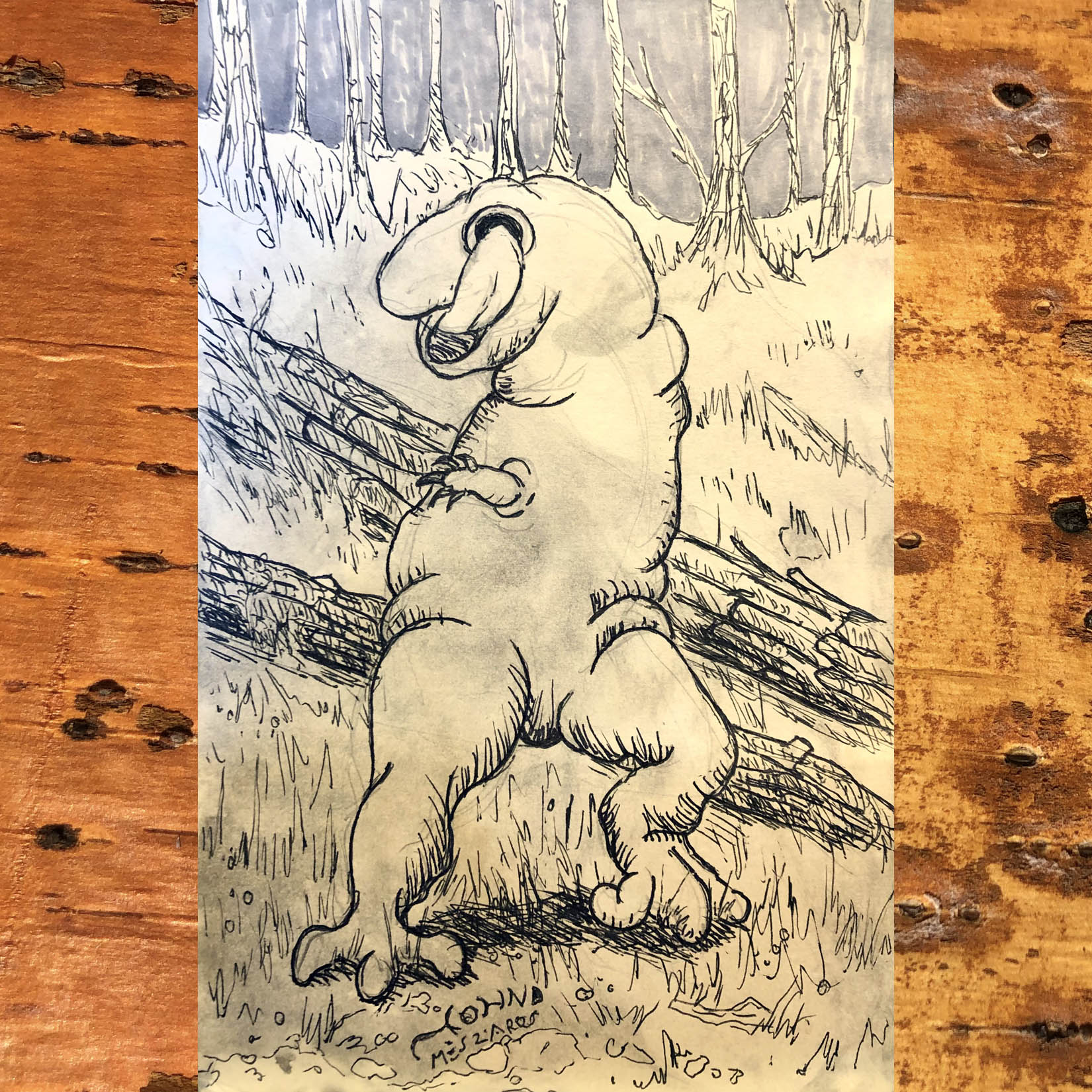
Been playing around recently with staining paper with tea. I love the aged look it creates, and the unusual patterns formed. The perfect look for making moody crypitid drawings.

This here is the Mountain Creature Caught Running Behind a Google Car, or Mocc for short. It's recently become somewhat popular on Twitter and Reddit after a user posted a blurry photo from a Google Streetview car that appears to show an odd, bipedal creature running along a line of trees in a wooded area. Or maybe it's just a weird-looking tree stump. Either way, it's a neat new addition to American internet folklore, and has already generated a fair amount of fan art, including mine!

Friday, June 10, 2022

Pride Cryptids

It's Pride Month, so I'm reposting all my LGBTQ+ Cryptid designs!


PRIDE VAN METER VISITOR


GENDERFLUID DOVER DEMON


TRANSGENDER FRESNO NIGHTCRAWLER

                                NONBINARY CRAWFORDSVILLE MONSTER


ASEXUAL TRUNKO

I also made a couple of Pride Mothmens for this year.

    AGENDER


BISEXUAL


NONBINARY


PANSEXUAL


TRANSGENDER

All designs are available on shirts at my Teepublic store or as stickers and art at my Redbubble shop. All profits go to LGBTQ+ charities!


Saturday, April 16, 2022

Rougarou- Louisiana


A strange, unearthly cry echoes across the mirrored surface of the Louisiana bayou, echoing off scattered cypress and tupelo dripping with Spanish moss. Is this merely the call of a wading bird? A lone puma? Or is it the shriek of the man-wolf creature known as the Rougarou?

Rougarou is a Cajun variation on “loup garou”, the French word for werewolf. France has a long history of werewolf folklore. In the 16th century these creatures were often blamed for crimes such as disappearances, animal killings, and particularly violent burglaries. In a parallel to the infamous witch hunts also taking place at the time, scared and panicked villagers would usually accuse someone living outside the societal norms of the time- such as a hermit in the woods, or a person with mental illness- as being the beast. Once accusations had been made, the condemned had little ability to defend themselves in court other than to “confess” to being a werewolf and implicate others in their ddeds.

Many legends existed to explain how one became a loup garou. Some men (medieval werewolves were almost always masculine) could change by putting on a wolf’s skin- a possible link to legends of the Norse berserker warriors who would don bear skins to take on the beast’s power. Some people would become werewolves through cannibalism and other debauchery. Catholic priests claimed that a man who didn’t observe Lent for seven straight years would become a werewolf.

Stories of the loup garou came to North America in the 17th century with French settlers in the Acadia region, located in what is now Eastern Canada. In the aftermath of the French and Indian War, the British colonial government took over the region and forcibly deported most of the ethnically French Acadians.  Many of these displaced people settled in Louisiana, originally a colony of France that was ceded to Spain in 1762. The Spanish government was fairly tolerant of the settlers, allowing them to continue their cultural practices- which included tales of the loup garou.

In modern times the rougarou has become more of a boogeyman to frighten children. Parents warn their kids not to misbehave or play in the swamp or else the beast will come for them. These stories usually do not make it clear if the creature is a transformed human or if it is always a humanoid beast akin to the Beast of Bray Road and other dogmen of the Midwest.

Despite- or, more likely, because of- its frightening appearance and behavior, the Rougarou has become a popular part of Louisiana culture. Costumes based on the creature frequently appear in Mardi Gras celebrations, and the city of Houma even has an annual festival themed around the creature.


SOURCES 

Thursday, September 30, 2021

Hairy Devils- Alaska


Stepping into the dense rainforest of Southeastern Alaska, one can’t helping feeling a strange sort of presence, as if something unknown and unseen were watching from the trees. Is this sensation merely a construct of the mind? The human tendency to anthropomorphize nature? Or is it possible there are ancient spirits and unknown beasts lurking among the dripping spruces and shadowy hemlocks?

Around 1900 a gold prospector named Harry D. Colp wrote a story of an alleged encounter between one of his companions and a pack of unknown entities in the Alaskan wilderness.  Colp had been lodging with the man, Charlie, along with a few other prospectors in a shack near the city of Wrangell.  Charlie had heard about a deposit of gold-bearing quartz in the nearby Thomas Bay area.  Packing three months of supplies, he set off alone to investigate the site, only to return less than a month later badly shaken and with neither supplies nor gold.

Charlie told Colp that upon arriving in Thomas Bay, he’d gone in search of a half-moon shaped lake where the gold could supposedly be found. After several days of searching, he finally locating the body of water at the foot of a glacier. He had only just gotten his bearings when he was horrified to see a pack of hairy “devils” swarming towards him from the shore.

Charlie described these beings as looking halfway between men and monkeys. They were “entirely sexless, their bodies covered with long, coarse hair, except where the scabs and running sores had replaced it.” The stench of the creatures made Charlie ill, and their screams and cries made him delirious. The beings chased him all the way back to Thomas Bay, where he passed out and woke up hours later floating in his canoe in the middle of the water.

Several decades after Harry Colp’s death, his daughter, Virginia, published the manuscript of the story under the title “The Strangest Story Ever Told”. Over the years this tale has become a popular piece of folklore in Southeastern Alaska.

Some have suggested that the beings Charlie encountered may have been kushtaka- shape-shifting otter-men from the folklore of the Tlingit people. Stories depict these creatures as malevolent tricksters who lure fishermen and hunters into the wilderness, only to drown them or transform them into more otter-men. They are often used as boogeymen to scare children aware from the dangers of the ocean. Yet, like shapeshifters in many cultures, kushtaka can be mercurial in behavior, and may occasionally save lost travelers from dying in the freezing cold (often, again, by turning them into kushtaka themselves). In at least one tale recorded by the Smithsonian Institute, an otter-man is depicted as the reborn spirit of a dead man who returns to aid his impoverished family. 

While Harry Colp never refers to the creatures in his story as kushtaka, the otter-men have become closely linked with “The Strangest Story Ever Told” in Alaskan folklore.

Other people have allegedly also seen the hairy devils around Thomas Bay, though Colp’s story is the only one widely known. These sightings have led locals to dub the area “Devil’s Country”. Thomas Bay is also known as the “Bay of Death” by the Tlingit people because of a landslide in the 1700s that wiped out a village.


SOURCES

Full text of "The Strangest Story Ever Told", from bigfootencounters.com

A story about a more benevolent encounter with a kushtaka

An interesting possible explanation for the Thomas Bay devils, from Tara Neilson's Alaska For Real blog

An article from the Juneau Empire with more details about Harry Colp

"Kushtaka", a short film created by Cameron Currin about the monstrous Otter-Men


Tuesday, May 11, 2021

Unktehi and Wakinyan- South Dakota


In every culture, in every era, humans have always been fascinated by monsters. We love to sit around the fire- or listen to the radio, or read a book, or play a video game- immersing ourselves in tales of dragons, gorgons, yokai, trolls, asuras, tokoloshe, and even stranger beings that lurk in the unseen corners of our world. The phenomena of cryptids is just the newest iteration of this fascination, though our modern age has added a scientific veneer onto these hidden monsters.

With that being said, I wanted to expand this list of state cryptids out beyond the European American legends to include mysterious beasts form other cultures of the North American continent.

Thunder beings and their rivals, the horned water serpents, are prominent in the legends of many Native American peoples, and are known under many names. Among the Lakota Sioux and other Native peoples of the American prairies, the Thunder Beings are known as Wakinyan, and the horned serpents called Unktehi. The Wakinyan often manifest as great birds to do battle with the serpents, smiting them with lightning and driving them into the Earth. Some legends say that the bones of both combatants can be found all over the American West, particularly in the prairies of Midwest and in the Badlands of South Dakota.

These bones are said to have great wakan, spiritual power similar to the Algonquian concept of manitou. People sometimes gather bones from Unktehi for medicine bundles. And there are stories of evil sorcerers using shards of horned serpent bones to “sting” or curse others.

In the late 1800s, European-American paleontologists such as Othniel Charles Marsh and Edward Drinker Cope came to the West in search of fossils. Guided by Native stories, they collected many of the monstrous bones and identified those of the Wakinyan as pterosaurs. Unktehi bones found on the grasslands were discovered to be from aquatic reptilian mosasaurs, while the bones from in badlands belonged to extinct mammals.

Why, one must wonder though, are the bones of marine animals found in the middle of the prairies? The answer lies in the late Cretaceous period when a long, shallow Interior Sea ran through North America, dividing the continent into the landmasses of Laurentia in the West, and Appalachia in the East. Mosasaurs, ichthyosaurs, and giant carnivorous fish such as Xiphactinus hunted these waters, while pterosaurs soured above the waves, and dinosaurs such as Tyrannosaurus and duck-billed hadrosaurs roamed the shores. Over millions of years, plate tectonics pushed up the floor of the Interior sea, leaving the bones of its prehistoric inhabitants entombed on dry land.


It's important to note that the cryptid commonly called a "Thunderbird" by many European Americans is distinct from the Wakinyan. While the former was definitely inspired by the legends of Native peoples, it tends to be thought of as a natural- if unusual- animal such as a giant bird or even a pterosaur. The Wakinyan, however, is a spiritual being that can take many forms. I've talked about the other type of Thunderbird- and an imfamous phantom photograph of one that everyone remembers, but no one can find- in a previous post.

SOURCES

Fossil Legends of the First Americans by Adrienne Mayor

Lakota Belief and Ritual by James R. Walker, edited by Raymond J. DeMallie and Elain A. Jahner

A legend of the Unktehi from the National Park Service website

Information on the "horned serpent" from Native-Language.org


Tuesday, March 23, 2021

Specter Moose- Maine


Among the pines, an apparition looms.  Towering twice the height of a man, the beast has the form of a moose, but is far bigger than any ordinary member of Alces alces.  Its coat is deathly white. Its antlers spread wide as outstretched arms, pronged with over two dozen sharp points. Is it a ghost? A spirit of the forest? Or perhaps it is merely an ordinary- if impressive- natural mutation.

The first recorded sighting of Maine’s spectral moose occurred in 1891 when hunting guide Clarence Duffy spotted the creature around Lobster Lake. A year later it was seen again by a sportsman from New York who shot at it, only to be chased down and nearly trampled by the vengeful beast.

Regular sightings occurred for several decades. Witnesses described the moose as being white or light gray, with some even claiming that it glowed dimly. It was said to be about 10-15 feet high at the shoulder, much taller than the 8-10 foot shoulder height of an average moose. Its antlers were said to be 10-12 feet wide and festooned with up to 22 prongs- much larger and more complex than the 4-6 foot spread of a regular moose. Some eyewitnesses claimed that the moose would actually vanish into thin air right in front of them.

Some have suggested that the animal was albino. Albino moose have indeed been documented many times, but their eyes are pink or violet, while the eyes of the spectral moose are said to be brown. Albinism would also not explain the creature’s tremendous size and enormous antlers.

Its possible the spectral moose had a condition similar to the Kermode Bears of British Columbia, also known as Spirit Bears or Moksgm’ol in the language of the Indigenous Kitasoo, a tribe of the Tsimshian people. Although these bears have white fur, their eyes and skin do have pigment. The white coloration is due to a recessive gene that stops melanin from being made only in the fur, a condition called leucism (as opposed to albinism, in which all pigmentation is lost in all tissues).

In fact, population of white moose are well-known to inhabit the woods around the town of Foleyet in Ontario. Like the Moksgm’al, these moose are not albino, instead possessing a recessive gene that makes their coats a grayish-white. Its quite possible that Maine’s spectral moose had a similar genetic condition, though again the creature’s alleged great size, and its seeming ability to disappear into thin air have not been fully explained. Perhaps eyewitnesses, startled by the sight of such an otherworldly-looking animal, exaggerated their descriptions.

SOURCES

An article from New England Folklore about the Spectral Moose

An article from Mysterious Universe about the Moose

An article from Lumberwoods.org

A Smithsonian article about the white Moksgm'ol Bear

Ontario's white moose

A 1911 article from the Sacramento Union about the Specter Moose

A post from legendsofamerica.com about the Specter Moose