My Other Sites

Showing posts with label anomalocaris. Show all posts

Thursday, February 2, 2017

Stego-Squid Festival Flyer


Here's part of a cross-over between my state cryptids blog and my "found object" fiction project, The Astarapomp Dossier

This is a flyer for a fictional festival in Grenhaven, Connecticut (my answer to H. P. Lovecraft's Arkham) celebrating the mysterious (and also fictional) Stego-squids that inhabit the estuary at the mouth of the Connecticut River.

Considering how big the Connecticut River is, and how important it has been to maritime history and trade in New England, it's rather sad that the river has no famous monsters to call its own. So I made some! See if you can guess what sort of creature the Stego-squid actually is. (Hint: it's not actually a cephalopod)

Tuesday, August 9, 2016

Fresno Nightcrawler Variant 2: Hyperdimensional Anomalocaris


Here's another speculative variation on the California "wishbone" cryptid.

Anomalocarids were a taxonomic group of large marine predatory invertebrates of the Paleozoic. Though they have no direct descendants, fossil evidence indicates that they were close relatives of arthropods, tardigrades and a small phylum of animals known as onycophorans, or velvet worms.

Various species of anomalocarids and their close relatives. Clockwise from top right: Schinderhannes bartelsi, Pambdelurion whittingtoni, Peytoia (Laggania) nathorsti, Anomalocaris canadensis, Amplectobelua symbrachiata, Hurdia victoria, Opabinia regalis, Kerygmachela kierkegaardi


Anomalocarids propelled themselves through the water using a series of lobes or fins along their sides that they waved in a sinuous motion rather like the wings of a stingray or the fins of a squid. The most distinctive feature of anomalocarids, however, was the pair of jointed Great Appendages that sprouted just in front of their mouths. In most species, these mandibles were adorned with sharp spines to help them capture and tear apart prey. Some of these creatures, however, developed into giant, gentle filter-feeders, using the elongated spines on their Great Appendages like strainers to catch plankton.

More anomalocarids. Top: Hurdia victoria. Bottom: Stanleycaris hirpex

Anomalocarid fossils were for a long time only known from the Cambrian period- the earliest age of large, multicellular mobile animals. But the discovery in 2009 of Schinderhannes bartelsi in the Hunsrück Slate of Germany extended their range all the way to the Devonian.

I've long been a fan of anomalocarids, as you can probably tell from all the drawings I've done of them. Heck, I've even designed a couple speculative species, like this one here.


My Speculative Hermit Anomalocaris, Repticaris caerulea.
In an interesting instance of life imitating art, one of my speculative animals even "predicted" the discovery of one of the first known filter-feeding anomalocarids called Tamisiocaris. Here's a picture of my invented animal, Cetimimus barbus:


And here's a reconstruction of Tamisiocaris by Rob Nicholls:


So, anyway, what's this got to do with the Fresno Nightcrawler? Well, while watching those two famous videos, I couldn't help noticing that the critter's legs looked a bit like anomalocarid Great Appendages (of course, when you've constantly got anomalocarids on the brain like me, it's not hard to see them everywhere). I started wondering: what if the weird "walking wishbone" we see is only a small part of a larger animal? What if the rest of it exists in another dimension we can't perceive? Perhaps the walking "legs" are actually modified mandibles that tow the animal along. Here I have imagined the creature's lateral swimming lobes having become huge flaps, forming a net or basket for capturing "astral plankton" which floats all around us just a few dimensions away. 

On a final note, this won't be the last time you see me interpret a cryptid as a sort of unusual anomalocarid. Stay tuned for more! 


Wednesday, October 1, 2014

The Crawfordsville Monster-- Indiana


This odd critter is classified among an obscure group of cryptids known as "atmospheric beasts".  These are beings that supposedly live high up in the atmosphere, within or above the clouds.  They come in many different forms-- jellyfish, ribbons, giant amoebae.  Some cryptozoologists even speculate that UFOs, rather than being spacecraft from other worlds, might actually be bizarre airborne life forms that either evolved here on Earth or migrated to our planet from elsewhere.

Sometimes when a meteor strikes Earth, it will be accompanied by an odd, slimy blob of tissue called "star jelly" which some believe may be the remains of atmospheric beasts struck by the falling stone.  There are cases, though, where the supposed star jelly turned out to be a colony of a perfectly natural terrestrial cyanobacteria called Nostoc or one of the many varieties of slime molds (colonial organisms which are fascinating in their own right).

On an interesting side note, Sir Arthur Conan Doyle, creator of Sherlock Holmes, wrote a short story, "The Horror of the Heights", which describes an aviators encounters with "air jungles" full of weird, translucent airborne monsters.
You can read the full story here

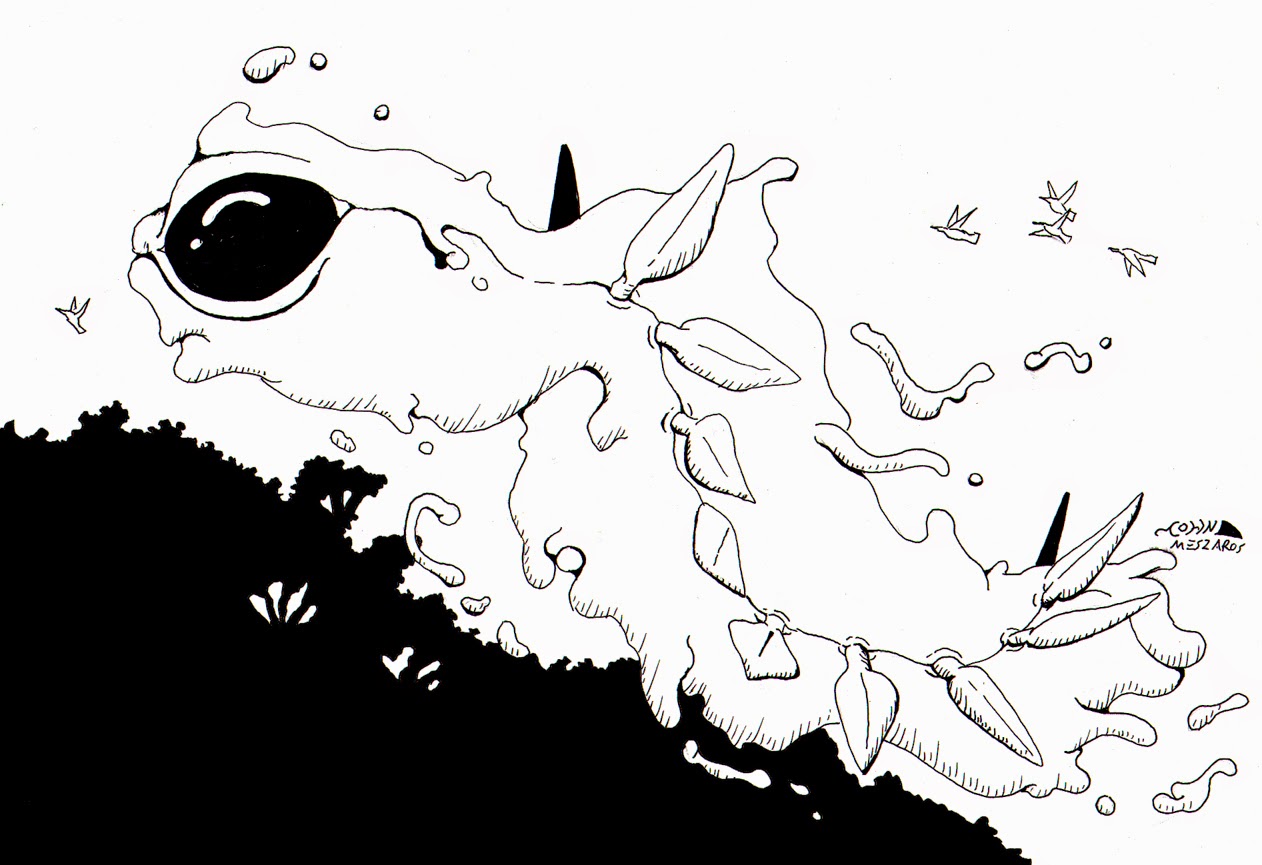
Anyway, about this Crawfordsville Monster.  In the early morning of September 5th, 1891, two ice delivery men, Marshal McIntyre and Bill Gray saw a bizarre creature diving and curling through the sky.  The Crawfordsville Journal later described it as:

about eighteen feet long and eight feet wide and moved rapidly through the air by means of several pairs of side fins. . . . It was pure white and had no definite shape or form, resembling somewhat a great white shroud fitted with propelling fins. There was no tail or head visible but there was one great flaming eye, and a sort of a wheezing plaintive sound was emitted from a mouth which was invisible. It flapped like a flag in the winds as it came on and frequently gave a great squirm as though suffering unutterable agony."

The creature was later seen by pastor G.W. Switzer, whose description was similar to the Journal's report.

Eventually, the nature of the monster was discovered when two witnesses, John Hornbeck and Abe Hernley followed it and discovered that it was..... nothing but a huge flock of kildeer. Apparently the shape of the massive cloud of birds that been misinterpreted due to the dim lighting and the fogginess of the early morning.

Like a lot of cryptids, the Crawfordsville Monster turned out to be a perfectly normal, known phenomenon distorted by human perception.  But even so, it still makes a pretty sweet creature.

For my interpretation, I wanted the body to have a bloby, amorphous quality like other atmospheric beasts, so I drew it with little wisps of goo trailing off it. I tried to show its fins moving in a synchronized wave like the lateral limbs of an anomalocarid.

Source:
http://www.lane-mchs.org/Crawfordsville%20monster.pdf