Here's an illustration I did of an unusual hairy cryptid from around Harrisburg, IL.for an article I wrote in Cryptid Culture magazine.
The Tuttle Bottoms Monster is unique among hairy cryptids because of its long, anteater-like snout.
For my interpretation of the beast, I imagined it as a chalicothere- a species of extinct, sloth-like animals distantly related to horses- that had evolved a long, gharial-like snouth for catching fish.
On the evening of April 25, 1973, a young boy named Greg
Garrett was playing in his backyard when an otherworldly creature burst from
the woods and attacked him. According to the boy’s description, the creature
was short and squat with skin was wrinkled and gray. Its eyes, big as plates,
were a strange bioluminescent pink. The monster had short, stubby arms and--
most bizarre of all- three legs. The beast jumped at Garrett and scratched at
his feet, tearing his shoes, before bounding away into the woods.
Less than an hour later, the Horror made a reappearance at
the house of Garrett’s neighbor, Henry McDaniel. This second encounter began
when McDaniel and his children heard scratching around the outside of the
house. Assuming it was a dog or other animal, McDaniel went to the door to
investigate. Upon opening it, he discovered on his porch the same gray,
wrinkled, tripodal beast apparently trying to get into his home. Panicking,
McDaniel slammed the door and grabbed a revolver from his bedroom. Returning to
confront the Horror, he fired a shot, hitting it point blank. But the creature
merely hissed at him and leapt away as before.
McDaneil saw the creature again on May 6, wandering around
the railroad tracks near his home. This time neither man nor monster attempted
any sort of contact. The Horror merely wandered around on the tracks for a bit
before once again hopping away .
Stories about Garrett and McDaniel’s encounters spread quickly.
Soon tourists were coming from everywhere in the hopes of catching a glimpse of
the Enfield Horror. To the dismay of many in this small town, the influx also
included several self-styled “monster hunters” looking to shoot the creature. The
last thing the residents wanted was people running around in the forest,
possibly drunk and possibly shooting anything that moved. Though something gray and otherworldly was
spotted a few times, both by hunters and locals, no one ever got as close of an
encounter with the beast as McDaniel did. And soon the furor over the Enfield
Horror died down.
So what exactly was this tripodal, gray-skinned creature?
Some have suggested that it was an escaped kangaroo or monkey whose tail was
misidentified as a third leg by the frightened witnesses. Others have
speculated that it might have been a mutated version of a regular animal,
perhaps even a mutated human being. Still others have wondered if it was a creature from another
planet or even a parallel dimension. Then, of course, there is the highly
likely possibility that the Horror was nothing more than a tall tale invented
by McDaniel. this scenario is increasingly likely when one learns that Garrett,
the only other person who saw the beast close up, later admitted that he had
invented his story after rumors had already begun spreading.
For my own speculative design of the Horror, I tried to base
it on a real animal rather than just making it an alien or ultraterrestrial.
But what known animal has three legs? I looked at the hypothesis that the
creature was a kangaroo and its tail was mistaken for a third limb. But I
wanted my Horror to be something stranger than just a misidentified marsupial.
Being a biology-minded guy who gravitates
towards the ocean world, my thoughts eventually drifted towards some sort of
marine creature. That’s when I realized the Enfield Horror had to be some sort
of giant land-walking frogfish.It
makes a lot of sense, of course. Frogfish, along with many other
bottom-dwelling anglerfish, have specialized pectoral fins that resemble the
arms of quadrapeds. They actually use these arms to move themselves over the
reefs they dwell on, or over the sandy bottom. Perhaps in the case of the
Horror, the creature’s tail had also evolved to act as a third limb to prop
itself up. The stubby hands, then, would be the fish’s modified pectoral fins.
There are actually other reports of fish, or fish-like
cryptids with limbs that allow them to walk on land. In 1953, for example, the
carcass of a strange, amphibious monster washed up on the beach at Canvey
Island, England. The monster was said to
have an enormous mouth lined with hundreds of small, sharp teeth, as well as a
pair of muscular back legs, but no apparent front limbs.
The Canvey Island Monster
Though it’s claimed that scientists who examined the carcass
could not identify it, photographs of the corpse clearly show that it was
nothing more than a partially decomposed Goosefish Lophius piscatorius. Like
their frogfish relatives, goosefish have fleshy, arm-like pectoral fins which
they used to move slowly over the muddy sea floor.
Goosefish Lophius piscatorius. Source: Arkive.org
But let’s take the speculative fiction route and imagine
that the Canvey Island Monster was something more? What if it, too, was of the
same bizarre amphibious fish species as the Enfield Horror? Or perhaps a close
relative, since it lacked the stubby arms derived from the pectoral fins. Perhaps
it was specialized for moving about in the shallows while it’s Illinois
relative was a more terrestrial lineage?
Intriguingly, there are a few (admittedly fictional)
accounts of goosefish crawling on land. The Stratford News of Connecticut
mentioned an incident on July 18, 1909 in which lighthouse keeper Theodore
Judson of Lordship, CT killed a large goosefish that had repeatedly hauled
itself out of the sea at night to raid his chicken coop. An earlier article
from 1906 mentions a man, also from Lordship, finding a large, wide-mouthed
fish-- clearly a goosefish, even from the sparse description in the paper-
crawling on the shore rocks with a pair of stubby feet. While both accounts are
more than likely just tall tales created to drum up newspaper sales, it’s entertaining
to imagine that perhaps these land-walking anglerfish were actually live
versions of the Canvey Island carcass.
On the evening of October 17, 1973, Falkville Alabama chief
of police Jeff Greenhaw received a call from an anonymous woman claiming she
had seen a UFO sail over her house and land in a nearby field. Though hesitant
to go out when he was already off duty, Chief Greenhaw got in his car to have a
look. When he arrived at the field no UFO could be found, so he decided to
drive around the area to see if there was anything in the area.
While cruising down a dirt path, Greenhaw spotted a person
standing on the side of the road. Thinking it might be someone in need of help,
he got out and approached the figure. Up close, however, he discovered that the
being was completely covered by some sort of metallic outfit. To quote
Greenshaw himself:
“It looked like his head and neck were kind of made
together... He was real bright, something like rubbing mercury on nickel, but
just as smooth as glass. Different angles give different lighting.... When I
saw him standing in the middle of the road I immediately stopped the car and
asked if he was a foreigner, but no sound came out of his mouth.”
Thinking quickly, Greenshaw ran back to his truck, grabbed
his camera and snapped several photographs of the creature before it ran off
into the night at speeds supposedly faster than a normal human could go.
And what exactly do Greenshaw’s photos depict? Well....
It’s pretty clear from this photo that the “alien” is
nothing more than someone in a metallic asbestos or radiation suit. It is worth
noting that this sighting came only a few days after the more famous alien
encounter along the Pascagoula River in Mississippi detailed in the previous
entry. Perhaps this “encounter” was staged in an attempt to ride on the fame of
the mummy-robot story.
The question, though, is whether Greenshaw was in on the
hoax or just an innocent bystander. If
the former, his participation in the events brought him nothing but misfortune.
His report on the encounter was widely ridiculed and eventually led to his job
as chief of police being terminated. Whether or not Greenshaw knew the being
was just a prank, that ending seems rather harsh.
Let’s imagine for a moment, though, that the Metal Man
actually WAS a genuine extraterrestrial (or perhaps extradimensional) entity.
Could the metallic exterior have been a space suit for an entity that was not
used to Earth’s atmosphere? Or is the creature’s similarity to the Pascagoula
mummy-robots more than superficial? Could it also have been some sort of
synthetic being? Perhaps a slightly different model of the Pascagoula creatures?
Maybe it was a probe sent out to explore an environment its creators could not?
Greenshaw does describe the being as
having stiff, robot-like movements.
Encounters with other apparently mechanical alien beings
have been reported on multiple occasions. These creatures come in a surprising
variety of shapes.
For example, in 1977, Antonia La Rubia of Paciencia, Brazil
reported being abducted on his way to work by beings with metallic scales and
tentacle-like arms. Each entity stood upon a single leg with a flared base that
La Rubia described as looking like the base of a barstool. Each creature also
carried a belt of syringe-like instruments. One of the beings used a syringe to
zap La Rubia with a blue light and carry him into a waiting space ship. Inside,
the robots used a piano-like device to show him a series of images, some of them
depicting himself being examined by blue lights from their instruments (though
La Rubia’s account makes no mention of him actually being examined. Perhaps
those memories were removed by the robots?).
They also drew some of his blood before returning him to Earth.
Another 1977 encounter with apparently robotic beings occurred
in Prospect, Kentucky. While driving home one night Lee Parish spotted a
rectangular craft hovering in the sky. When he finally arrived home he
discovered a half hour gap missing from his memory. Under hypnosis Parish
recalled being brought aboard the strange craft where he was confronted by
three blocky, mechanical creatures. The largest being resembled a “tombstone”
and had a single jointed arm jutting out of it. Another, shorter being was pure
white with a rough “head” and arms that did not move. Though the beings never
spoke, Parish got the impression that this one was somehow the leader. The
smallest being was bright red and had a single, unjointed limb projecting from
it.
The red and black machine-creatures examined Parish (the
black one apparently causing a painful cold, burning feeling when it’s limb
contacted him) while the white being observed. Once the machines were done with
their examination they merged with one another and vanished, at which point
Parish was returned to his car.
Yet another strange encounter with mechanical aliens occurred
in 1951 over the skies of Georgia. Pilot Fred Reagan was flying his plane when
he was sucked upwards by an unknown force and crashed into a lozenge-shaped
UFO. Reagan immediately found himself teleported inside the craft, where he was
met by three foot tall metal aliens that he described as looking like asparagus
stalks.
The beings apologized for the crash and gave him a medical
exam to make sure he was not injured. During
the procedure, so Reagan claims, they found cancer within his body and removed
it as an apology for the trouble they had caused. The robots then deposited him
safely in a field next to the wreckage of his plane. On an unnerving side note,
Reagan died less than a year later due to brain tissue damage which was
believed to have been caused by exposure to high levels of radiation.
This variety of unusual robotic beings raises some
interesting speculative questions. Is each type sent out by a different alien
species? Or is it possible that there is just one investigating alien species
and each variety of robot is simply a different design used for a specific
purposes that the humans do not comprehend?
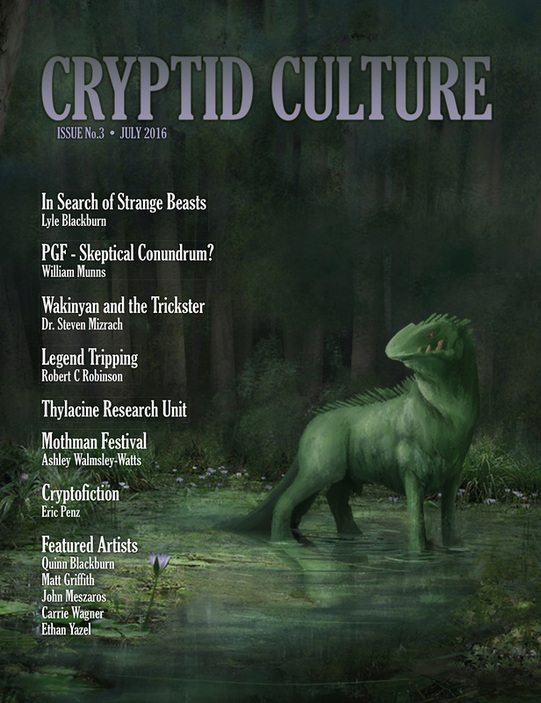
Hey everyone, I recently wrote an article for Cryptid Culture magazine talking about my blog.
To quote the magazine's own blurb:
"Cryptid Culture Magazine is a new print publication based on Long Island, NY. The idea for this magazine began in early 2015 when Brian Richardson, founder and designer for Mythic Articulations, came up with the idea of an art magazine that could gather all of the 'cryptid art' and artists he was discovering through his company. Expanding that, we began to believe there might be an audience for such a magazine if it could include not only visual art but fiction, essays, poetry etc. as well as content covering the influence of cryptids on books, film, TV, gaming, fashion, social media and science; really anything that might fall under the purview of 'cryptid culture' including interviews with cryptozoologists.
We envision Cryptid Culture as being a celebration of all things cryptid. We would like to include sightings, accounts and theories, remaining respectful of all opinions and insights from contributors with our own slant falling on neither the skeptic or believer side but promoting the interests of both with the dignity and respect each deserves. We will strive to make Cryptid Culture a high quality magazine with beautiful design and intriguing content and we would love to have you be a part of it."
On the cool evening of October 11th, 1973, Charles Hickson
and his friend Calvin Parker, Jr. were fishing off a pier on the Pascagoula
River. As they watched, a football-shaped, glowing craft zipped down
from the sky and hovered over the river. Three bizarre beings floated out of the
ship and approached the men. Hickson described the extraterrestrials as “robots”
with wrinkled gray skin like an elephant’s, and claw-like hands. Their
bullet-shaped heads had no necks, instead merging seamlessly into their
shoulders. The creatures had slits for mouths and carrot-like growths where their noses and ears wouldhave be. They did not appear to have any eyes.
Their cylindrical legs appeared to be welded together.
The alien robots somehow paralyzed Hickson and Parker and
took them back to their ship. There, the men were floated into a bright, empty
room and scanned by a football-shaped mechanical eye. According to Hickson, Parker quickly passed out during the encounter. Years later, under hypnosis, he would recall seeing shadowy beings watching the procedure from another
compartment. Perhaps these were the creators and controllers of the wrinkled
robots.
After a short while, both men were returned to
the pier. Once able to move again, they
ran to their car and sat for a long time, regaining their composure.
So what exactly happened to Hickson and Parker that night on
the Pascagoula River? Were they indeed paralyzed by wrinkled robots and taken
about a spacecraft? Were the beings from another planet? Another dimension (perhaps the same higher dimension that was the possible home of the Van Meter Visitor and other bizarre phantoms)?
Or was the whole encounter a vivid, terrifying hallucination? Joe Nickell,
Ph.D., a Senior Research Fellow of the Committee for Skeptical Inquiry (CSA) wrote an interesting article for the May/June 2012 issue of Skeptical Inquirer magazine which postulates that Hickson may have actually experienced a
hypnagogic episode.
Hypnagogia is the state between waking and sleeping where
some people can experience vivid, dream-like hallucinations, often including strange lights and visions of frightening beings. Many people also report sleep paralysis during
this time-- a condition caused by the body being in “sleep mode”, though the mind
is still partially active.
Hallucinations and sleep paralysis, so Nickell
hypothesizes, might explain the bizarre appearance of the wrinkled robots, as well as
the way they paralyzed the two men. Parker, as was mentioned before, fell asleep at
the beginning of the alleged encounter and did not wake up until afterwards. He
only recalled details of the incident later. Perhaps his "recovered memories" were influenced by Hickson’s own genuine belief in the encounter.
Hypnogogic hallucination it may have been, but regardless
the experience still haunted the men for years afterwards. Both suffered
mental trauma from what they believed they saw. Parker was supposedly even
hospitalized at one point after an emotional breakdown.
In an interesting possible sequel to this encounter, just six days later a metallic, wrinkly, robot-like being somewhat similar to the Pascagoula aliens was reported in Falkville, Alabama. I'll be detailing that incident in my next entry.
The idea of a freshwater octopus isn’t too outlandish,
especially compared to some of the cryptids on this blog. Other marine animals
have made the jump to lakes and rivers, including mussels, clams, snails,
bryozoans and jellyfish (though the biologist in me is compelled to note that
the freshwater jellyfish, Craspedacusta
sowerbii, is of the class Hydrozoa rather than Scyphozoa, which are the “true
jellyfish” like moon jellies, lion’s mane, upside-down Cassiopeia jellies and others). The bull shark, Charcharhinus leucas, is infamous for its
habit of swimming up estuaries into freshwater. There is even a rare group of
poorly-understood, exclusively freshwater sharks in the genus Glyphisthat inhabit the Ganges and
Irrawaddy rivers. Taking all these into account, it isn’t a huge stretch to
imagine an animal as intelligent and curious as the octopus evolving to live in freshwater.
Perhaps this has, in fact, happened, if urban legends about gigantic
octopi inhabiting lakes in Oklahoma are to be believed. According to rumor,
Lake Thunderbird, Lake Oolagah and Lake Tenkiller are all home to red,
truck-sized cephalopods that may be responsible for the upswing in drownings in
recent decades.
The Devil's Lake Monster
This is actually not the only time freshwater cephalopods have
appeared in legend. Devil’s Lake in Wisconsin is said to be haunted by two
distinct types of monsters. One is a classic Nessie-style plesiosaur. The other
is a tentacled beast that was said to have attacked a canoe of Native American
men paddling across the lake to more fertile hunting grounds. The origin of
this particular story is hard to trace. It’s unclear if it genuinely originated
with the Nakota Sioux who call the land around Devil’s Lake home, if it was an
invention of European settlers, or if perhaps it was even a modern invention
given a precolonial setting to try to create more legitimacy.
The Berkeley Square Horror
Another, more ambiguously cephalopodic cryptid comes from
London. The house at 50 Berkeley Square in the West End was infamous in the
18th and 19th centuries for being haunted by a shapeless gray Thing. Though the
bottom floor of the house has been consistently occupied, the second floor
rooms have long been left empty because anyone who sleeps in them will,
according to the legend, will literally be frightened to death by a visit from the
Thing in the middle of the night. Calling the Berkeley Square Horror an octopus
is, admittedly, a bit of a stretch. Descriptions of the entity are vague and
contradictory. Some witnesses said it looked like a collection of shadows or an
amorphous blob. Others claimed it
was a twisted, man-like specter. At
least one witness, though, did describe the Horror as a bizarre, tentacled
creature like a deformed octopus. Assuming the Horror was not something
supernatural, perhaps it was indeed a species of freshwater octopus that found
its way up the Thames and into London’s vast sewer system, where it eventually
emerged in the Berkely Square house.
While the marine ancestors of the Berkely octopus may have
migrated into the Thames via it’s link to the North Sea, it is more difficult to
imagine how cephalopods could have moved deep into the land-locked interior of
North America. This is further compounded by the fact that none of the lakes
inhabited by America’s supposed freshwater octopi have outlets to the sea.
Devil’s Lake lies at the bottom of a closed drainage basin-- a glacially-created
valley that does not link to any rivers with links tot he sea. Lakes Thunderbird, Oolagah and Tenkiller,
furthermore, are reservoirs created in the 1940s and 50s. How then could octopi
even get into any of these bodies of water?
Octosquatch
Well, maybe they just walked. Terrestrial, octopus-like
cryptids have been occasionally sighted around the world. In 1961, two Spanish truck drivers reported
encountering an odd creature covered in rust-colored fur that stood upon four
tentacle-like limbs. Octopi are actually
known to venture out of the water for short periods of time, usually when they
are moving between tide pools in search of prey. Perhaps some evolved an even
more amphibious existence and took to venturing farther and farther inland in
search of food.
Hairy Octopus from www.nad-lembeh.com
Even the unusual “fur” on this Octosquatch is not unprecedented.
A small species of taxonomically undescribed hairy octopus is known to inhabit the waters
around Indonesia. The filaments covering this creature’s body-- which are
extensions of its skin rather than the genuine fur of mammals-- are believed to
provide camouflage in the furry red algae common to the creature’s habitat.
Perhaps the land-walking cephalopod also developed a similar covering, though
in its case the filaments may have been used to provide insulation and possibly
to hold water against its body during terrestrial excursions.
Perhaps an Octosquatch-like species gradually made its way
into North America, using freshwater lakes as stepping stones. Over time, this
creature may have lost its terrestrial abilities and become fully aquatic
again, eventually becoming the enigmatic monsters terrorizing swimmers and
Native exploration parties in the Midwest.