My Other Sites

Tuesday, October 25, 2022

BOOK REVIEW: The Old Snatchengrabber's Big Book of Child-Eating Monsters


 Over on my other social medias I've been doing some reviews of horror books for Spooky Season, and I thought this book, being about boogeymen and other folklore bugbears, would fit in nicely with this blog.

THE OLD SNATCHENGRABBER'S BIG BOOK OF CHILD-EATING MONSTERS 

by Bitter Karella (writing as Mike Rosen)

Boogey-men, women, and those in-between abound in this collection of monstrous beings that live under beds, on the roof, or just on the edge of the forest path, waiting to grab and devour kids who misbehave or go to places they shouldn’t.

The Big Book ranges from familiar bogeys (at least to American pop culture) such as Rawhead Bloodybones, La Llorona, and Baba Yaga, to more obscure beings such as the Babylonian sewer-dwelling Sulak, the gossip-eating living marionettes called Croquemitaines, and the fungal witch Churnmilk Peg who punishes naughty children who steal unripe nuts from their neighbors’ orchards. All brought to life with Karella’s cartoony style.

Each entry is written in a field guide style with habitat, range, appearance, diet, and other vital statistics so you can identify the bugbear currently haunting your outhouse or crawlspace.  Looking through the entries, it quickly becomes apparent how hilariously gruesome boogeymonster folklore is, with monsters delivering punishments such as chopping kids to pieces; grinding them into sausage; suffocating them in piles of filth and sewage, ripping out their living guts and replacing them with stones, and other unpleasentries. I suppose if your kids won’t listen to reason, you gotta terrify them with the threat of dismemberment by a nightmare hag to get them to obey.

The Old Snatchengrabber’s Big Book of Child-eating Monsters is available as a PDF on Bitter Karella’s itch.io page, along with a bunch of other cool, spooky comics, books, and games- including the award-winning Midnight Pals!

Monday, October 24, 2022

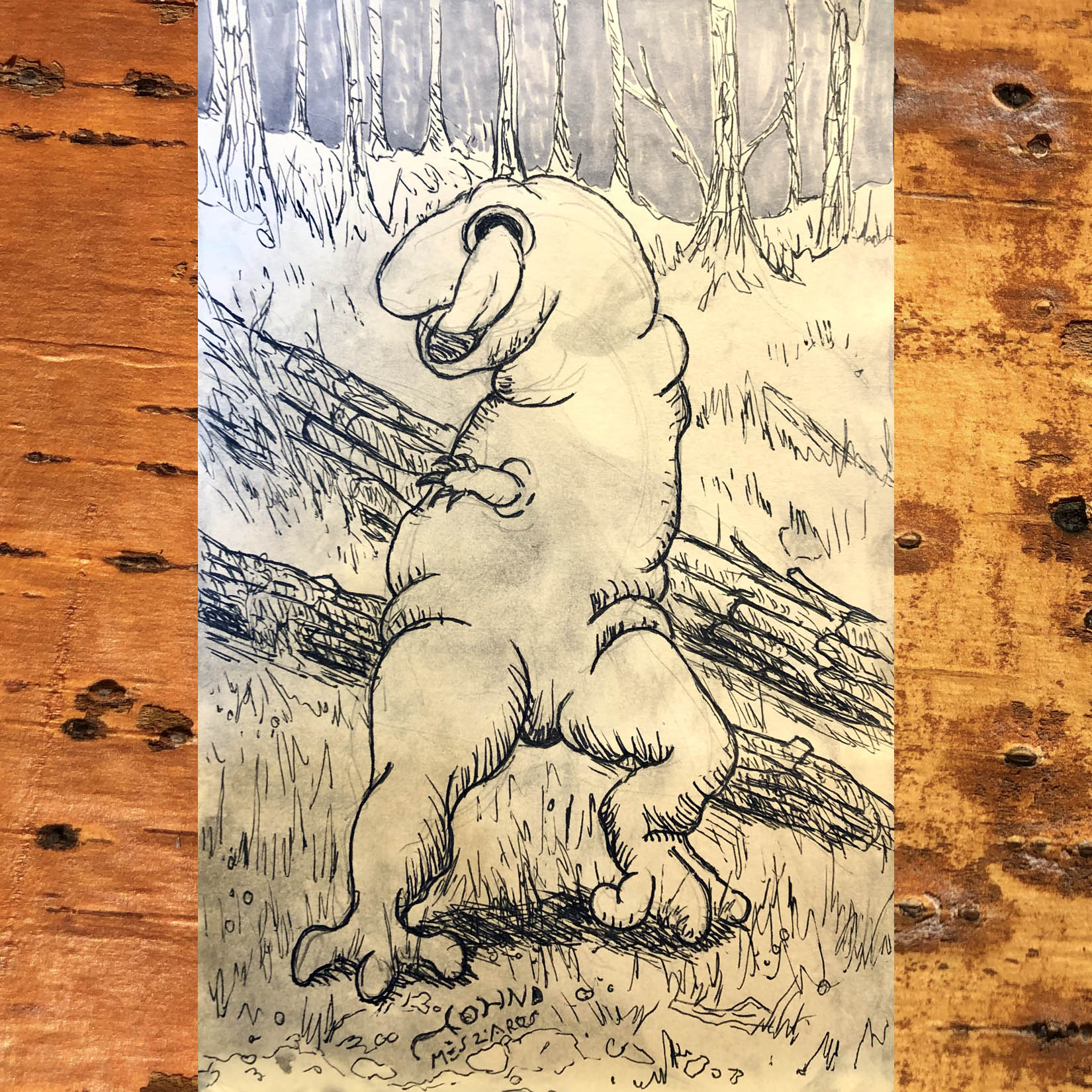
Flatwoods Monster Reimagined


Besides cryptids, my other favorite creatures to draw are radiodonts, aka anomalocarids. These "strange shrimp" were a diverse group of predators from the Paleozoic era that captured prey using spiky Great Appendages that hung from their heads in front of their mouths. Radiodonts are believed to be ancestral to both arthropods and velvet worms. 

Here I've reimagined the famous Flatwoods Monster as an upright, land-walking radiodont/anomalocarid with its Great Appendages forming the arms.

Wednesday, October 19, 2022

Mountain Creature Caught Running Behind a Google Car


Been playing around recently with staining paper with tea. I love the aged look it creates, and the unusual patterns formed. The perfect look for making moody crypitid drawings.

This here is the Mountain Creature Caught Running Behind a Google Car, or Mocc for short. It's recently become somewhat popular on Twitter and Reddit after a user posted a blurry photo from a Google Streetview car that appears to show an odd, bipedal creature running along a line of trees in a wooded area. Or maybe it's just a weird-looking tree stump. Either way, it's a neat new addition to American internet folklore, and has already generated a fair amount of fan art, including mine!

Friday, June 10, 2022

Pride Cryptids

It's Pride Month, so I'm reposting all my LGBTQ+ Cryptid designs!


PRIDE VAN METER VISITOR


GENDERFLUID DOVER DEMON


TRANSGENDER FRESNO NIGHTCRAWLER

                                NONBINARY CRAWFORDSVILLE MONSTER


ASEXUAL TRUNKO

I also made a couple of Pride Mothmens for this year.

    AGENDER


BISEXUAL


NONBINARY


PANSEXUAL


TRANSGENDER

All designs are available on shirts at my Teepublic store or as stickers and art at my Redbubble shop. All profits go to LGBTQ+ charities!


Saturday, April 16, 2022

Rougarou- Louisiana


A strange, unearthly cry echoes across the mirrored surface of the Louisiana bayou, echoing off scattered cypress and tupelo dripping with Spanish moss. Is this merely the call of a wading bird? A lone puma? Or is it the shriek of the man-wolf creature known as the Rougarou?

Rougarou is a Cajun variation on “loup garou”, the French word for werewolf. France has a long history of werewolf folklore. In the 16th century these creatures were often blamed for crimes such as disappearances, animal killings, and particularly violent burglaries. In a parallel to the infamous witch hunts also taking place at the time, scared and panicked villagers would usually accuse someone living outside the societal norms of the time- such as a hermit in the woods, or a person with mental illness- as being the beast. Once accusations had been made, the condemned had little ability to defend themselves in court other than to “confess” to being a werewolf and implicate others in their ddeds.

Many legends existed to explain how one became a loup garou. Some men (medieval werewolves were almost always masculine) could change by putting on a wolf’s skin- a possible link to legends of the Norse berserker warriors who would don bear skins to take on the beast’s power. Some people would become werewolves through cannibalism and other debauchery. Catholic priests claimed that a man who didn’t observe Lent for seven straight years would become a werewolf.

Stories of the loup garou came to North America in the 17th century with French settlers in the Acadia region, located in what is now Eastern Canada. In the aftermath of the French and Indian War, the British colonial government took over the region and forcibly deported most of the ethnically French Acadians.  Many of these displaced people settled in Louisiana, originally a colony of France that was ceded to Spain in 1762. The Spanish government was fairly tolerant of the settlers, allowing them to continue their cultural practices- which included tales of the loup garou.

In modern times the rougarou has become more of a boogeyman to frighten children. Parents warn their kids not to misbehave or play in the swamp or else the beast will come for them. These stories usually do not make it clear if the creature is a transformed human or if it is always a humanoid beast akin to the Beast of Bray Road and other dogmen of the Midwest.

Despite- or, more likely, because of- its frightening appearance and behavior, the Rougarou has become a popular part of Louisiana culture. Costumes based on the creature frequently appear in Mardi Gras celebrations, and the city of Houma even has an annual festival themed around the creature.


SOURCES 

Thursday, September 30, 2021

Hairy Devils- Alaska


Stepping into the dense rainforest of Southeastern Alaska, one can’t helping feeling a strange sort of presence, as if something unknown and unseen were watching from the trees. Is this sensation merely a construct of the mind? The human tendency to anthropomorphize nature? Or is it possible there are ancient spirits and unknown beasts lurking among the dripping spruces and shadowy hemlocks?

Around 1900 a gold prospector named Harry D. Colp wrote a story of an alleged encounter between one of his companions and a pack of unknown entities in the Alaskan wilderness.  Colp had been lodging with the man, Charlie, along with a few other prospectors in a shack near the city of Wrangell.  Charlie had heard about a deposit of gold-bearing quartz in the nearby Thomas Bay area.  Packing three months of supplies, he set off alone to investigate the site, only to return less than a month later badly shaken and with neither supplies nor gold.

Charlie told Colp that upon arriving in Thomas Bay, he’d gone in search of a half-moon shaped lake where the gold could supposedly be found. After several days of searching, he finally locating the body of water at the foot of a glacier. He had only just gotten his bearings when he was horrified to see a pack of hairy “devils” swarming towards him from the shore.

Charlie described these beings as looking halfway between men and monkeys. They were “entirely sexless, their bodies covered with long, coarse hair, except where the scabs and running sores had replaced it.” The stench of the creatures made Charlie ill, and their screams and cries made him delirious. The beings chased him all the way back to Thomas Bay, where he passed out and woke up hours later floating in his canoe in the middle of the water.

Several decades after Harry Colp’s death, his daughter, Virginia, published the manuscript of the story under the title “The Strangest Story Ever Told”. Over the years this tale has become a popular piece of folklore in Southeastern Alaska.

Some have suggested that the beings Charlie encountered may have been kushtaka- shape-shifting otter-men from the folklore of the Tlingit people. Stories depict these creatures as malevolent tricksters who lure fishermen and hunters into the wilderness, only to drown them or transform them into more otter-men. They are often used as boogeymen to scare children aware from the dangers of the ocean. Yet, like shapeshifters in many cultures, kushtaka can be mercurial in behavior, and may occasionally save lost travelers from dying in the freezing cold (often, again, by turning them into kushtaka themselves). In at least one tale recorded by the Smithsonian Institute, an otter-man is depicted as the reborn spirit of a dead man who returns to aid his impoverished family. 

While Harry Colp never refers to the creatures in his story as kushtaka, the otter-men have become closely linked with “The Strangest Story Ever Told” in Alaskan folklore.

Other people have allegedly also seen the hairy devils around Thomas Bay, though Colp’s story is the only one widely known. These sightings have led locals to dub the area “Devil’s Country”. Thomas Bay is also known as the “Bay of Death” by the Tlingit people because of a landslide in the 1700s that wiped out a village.


SOURCES

Full text of "The Strangest Story Ever Told", from bigfootencounters.com

A story about a more benevolent encounter with a kushtaka

An interesting possible explanation for the Thomas Bay devils, from Tara Neilson's Alaska For Real blog

An article from the Juneau Empire with more details about Harry Colp

"Kushtaka", a short film created by Cameron Currin about the monstrous Otter-Men


Tuesday, May 11, 2021

Unktehi and Wakinyan- South Dakota


In every culture, in every era, humans have always been fascinated by monsters. We love to sit around the fire- or listen to the radio, or read a book, or play a video game- immersing ourselves in tales of dragons, gorgons, yokai, trolls, asuras, tokoloshe, and even stranger beings that lurk in the unseen corners of our world. The phenomena of cryptids is just the newest iteration of this fascination, though our modern age has added a scientific veneer onto these hidden monsters.

With that being said, I wanted to expand this list of state cryptids out beyond the European American legends to include mysterious beasts form other cultures of the North American continent.

Thunder beings and their rivals, the horned water serpents, are prominent in the legends of many Native American peoples, and are known under many names. Among the Lakota Sioux and other Native peoples of the American prairies, the Thunder Beings are known as Wakinyan, and the horned serpents called Unktehi. The Wakinyan often manifest as great birds to do battle with the serpents, smiting them with lightning and driving them into the Earth. Some legends say that the bones of both combatants can be found all over the American West, particularly in the prairies of Midwest and in the Badlands of South Dakota.

These bones are said to have great wakan, spiritual power similar to the Algonquian concept of manitou. People sometimes gather bones from Unktehi for medicine bundles. And there are stories of evil sorcerers using shards of horned serpent bones to “sting” or curse others.

In the late 1800s, European-American paleontologists such as Othniel Charles Marsh and Edward Drinker Cope came to the West in search of fossils. Guided by Native stories, they collected many of the monstrous bones and identified those of the Wakinyan as pterosaurs. Unktehi bones found on the grasslands were discovered to be from aquatic reptilian mosasaurs, while the bones from in badlands belonged to extinct mammals.

Why, one must wonder though, are the bones of marine animals found in the middle of the prairies? The answer lies in the late Cretaceous period when a long, shallow Interior Sea ran through North America, dividing the continent into the landmasses of Laurentia in the West, and Appalachia in the East. Mosasaurs, ichthyosaurs, and giant carnivorous fish such as Xiphactinus hunted these waters, while pterosaurs soured above the waves, and dinosaurs such as Tyrannosaurus and duck-billed hadrosaurs roamed the shores. Over millions of years, plate tectonics pushed up the floor of the Interior sea, leaving the bones of its prehistoric inhabitants entombed on dry land.


It's important to note that the cryptid commonly called a "Thunderbird" by many European Americans is distinct from the Wakinyan. While the former was definitely inspired by the legends of Native peoples, it tends to be thought of as a natural- if unusual- animal such as a giant bird or even a pterosaur. The Wakinyan, however, is a spiritual being that can take many forms. I've talked about the other type of Thunderbird- and an imfamous phantom photograph of one that everyone remembers, but no one can find- in a previous post.

SOURCES

Fossil Legends of the First Americans by Adrienne Mayor

Lakota Belief and Ritual by James R. Walker, edited by Raymond J. DeMallie and Elain A. Jahner

A legend of the Unktehi from the National Park Service website

Information on the "horned serpent" from Native-Language.org