My Other Sites

Tuesday, January 16, 2024

Devil Monkeys- Virginia


Though South America, Central America and southern Mexico have a great diversity of primates, northern North America has none aside from humans. This is ironic given that the earliest known primate- a small, squirrel-like creature called Purgatorius- evolved on this continent.  Descendants of Purgatorius and its relatives diversified into several lineages of tarsier- and lemur-like forms that inhabited North America during the warm Eocene epoch before supposedly dying out as the land grew cooler and grasslands became more abundant.

A fossil find in 1960s altered this view when molars from a lemur-like creature dubbed Ekgmowechasala (Sioux for “Little Cat Man”) were unearthed on the Pine Ridge Indian Reservation in South Dakota. This animal lived in the Oligocene, millions of years after other primates were thought to have died out, proving that at least a few of these lines had continued. Though no younger North American primate fossils have been found since, what if descendants of Ekgmowechasala survived into the present day?

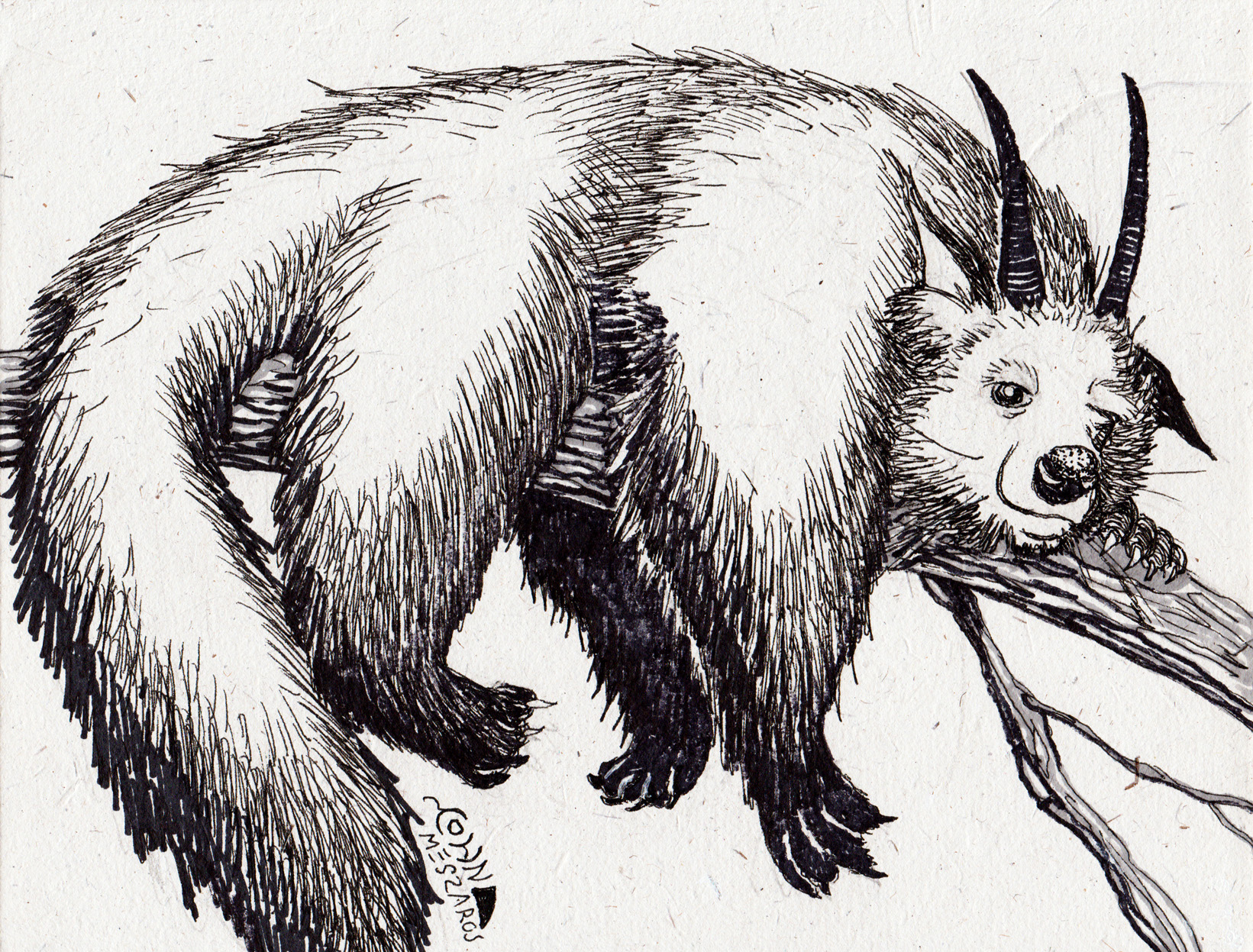
In 1959 a couple by the name of Boyd were driving home near Saltville, Virginia when a strange, monkey-like beast attacked their car. They described it as having light “taffy-colored” fur with a white belly, and powerful, muscular legs. Other people in the Saltville area reported seeing a similar creature around the same time.

Then in the 1990s a woman driving on a dark Virginia backroad saw a creature run in front of her car that she described as black and sleek with a long tail, pointy ears, a short-snouted face, a man-like torso, and powerful hind legs. Though the earlier Boyd cryptid bears little resemblance to this animal- and may in fact have been a different species- both incidents have been conflated in pop culture as encounters with what have come to be called devil monkeys.   

While the Virginia encounters are the most well-known sightings, devil monkeys have been seen throughout North America.  Coweta County, Georgia, for example, is haunted by the Belt Road Booger, a simian creature with a “flat, beaver-like tail covered in hair”. Run-ins with the Booger began in the 1970s, many of them now believed to have been hoaxes by pranksters dressed in gorilla costumes. But other encounters have not yet been fully explained. The Belt Road Booger has become such a local sensation that a taxidermist in Newnan, Georgia even made a fake “Booger” head out of a white-tailed deer’s posterior as a decoration for a friend’s hardware store.

There is also possible photographic evidence of a devil monkey. In 1996 photos surfaced online of a strange, furry, baboon-like carcass lying along the curb of a Louisiana highway. Dubbed the Deridder Roadkill, the body bears a distinct resemblance to descriptions of these cryptids with its long snout, bushy-haired body, and ape-like feet. While some have suggested the carcass was a devil monkey, others have proposed that it could be a rougarou, dogman, or even a chupacabra. More mundane suggestions include a large Pomeranian dog, or even a prop. However, as so often happens in these cases, the body disappeared before samples could be taken, so its identity could not be proved definitively.

Devil monkeys are often said to have powerful kangaroo-like hind legs that allow them to jump huge distances. This feature has led some cryptozoologists to wonder if widely reported “phantom kangaroos” sighted throughout the US and Canada might actually be these animals.

While stories of large non-human North American primates like sasquatch and skunk apes are abundant in folklore and cryptozoology, no fossil evidence for these creatures has been found. Thus if they are real, one could argue that they likely migrated to this continent late in geological history along the same routes that humans used. Devil monkeys, on the other hand, may represent a species of home-grown North American primate possibly descended from Ekgmowechasala or similar animals.


REFERENCES

Eons. (20, November 12). What happened to primates in North America? [Video]. PBS.org. https://www.pbs.org/video/the-first-and-last-north-american-primates-dztigm/#:~:text=Why%20don't%20we%20have,and%20eventually%20they%20all%20disappeared.

Gilly, Steve. (2018, April 20). The Devil Monkey. MountainLore. https://mountainlore.net/2018/04/20/the-devil-monkey/

Grundhauser, Eric. (2016, December 22). Does America have a secret kangaroo population? Atlas Obscura. https://www.atlasobscura.com/articles/does-america-have-a-secret-kangaroo-population

Leftwich, Rebecca. (2023, October 30). Who put the “boo” in the Belt Road Booger? The Newnan Times-Herald. https://www.times-herald.com/news/who-put-the-boo-in-the-belt-road-booger/article_ee9d689e-770f-11ee-a003-8bb851ca9cb4.html

Lynch, Brendan M. (2023, November 6). Fossils tell tale of last primate to inhabit North America before humans. University of Kansas. https://news.ku.edu/2023/11/06/fossil-evidence-tells-tale-last-primate-inhabit-north-america-humans#:~:text=The%20first%20primates%20came%20to,about%2034%20million%20years%20ago.

Morphy, Rob. (2010, January 13). Deridder Roadkill: (Louisiana, USA). Cryptopia. https://www.cryptopia.us/site/2010/01/deridder-roadkill-louisiana-usa/

Morphy, Rob. (2010, December 6). Devil monkeys: (North America). Cryptopia. https://www.cryptopia.us/site/2010/12/devil-monkeys-north-america/

Spooky Appalachia. (2023, April 26). The story of the Virginia devil monkey. [Video]. YouTube. https://www.youtube.com/watch?v=Nsv-mBSEX74

Taylor, Jr. L. B. (2012). Monsters of Virginia. Stackpole Books.


Saturday, May 6, 2023

Ozark Howler- Arkansas


The Ozarks are a range of low mountains found primarily in Northern Arkansas and southern Missouri with portions extending into Oklahoma and Kansas.   Their origins lie in the late Paleozoic when sand, silt, coral, and shells built up as layers of sludge on the bottom of a sea that covered what would eventually become the American South. Over time these sediments hardened into rock- sand became sandstone, silt became slate, and the shells and coral became limestone- and the movement of tectonic plates pushed them upwards into a low dome-like plateau.  Over the next 485 million years rivers and rain gradually eroded the soft rocks into canyons, cliffs, and caves that have provided habitat for bears, bobcats, otters and other Southern wildlife along with more unusual creatures like blind cave fish, collared lizards and endangered grey bats. And perhaps a cryptid or two.

According to legend, the people of the Ozarks have been haunted for decades by the unearthly screams of a beast dubbed the Black Howler.  Those who have caught a glimpse of the monster describe it as a dark-furred cat nearly the size of a bear. Other reports claim it has glowing red eyes and demonic horns sprouting from its head.

Explanations for the beast range from a normal, though unknown, species of large cat to something more supernatural. A few people have even compared the beast to English and Welsh legends of black dogs, cŵn annwn, hellhounds, and other supernatural beasts that bring misfortune to those who see them.

More skeptical people have speculated that the Howler is simply a misidentified cougar. Though these big cats are believed to be extinct in this region, it’s possible that a small population has survived. Or perhaps a few lone individuals have wandered in from other areas. This theory is bolstered by photos from trail cams showing creatures that strongly resemble these animals, and by similar cases of “phantom big cats” occurring in areas of the US where they are not normally found.

Though some claim that legends of the Howler go back generations, cryptozoologist Loren Coleman has found that the first reports of the beast originated from posts on online forums in the late 1990s. His investigations indicate that the “folklore” about the beast was a deliberate hoax to mock the widespread reports of chupacabras and bigfoots that were becoming increasingly widespread at the time thanks to the advent of the internet. Hoax it may be, but the Howler has since become a popular piece of Ozark folklore and sightings are still regularly reported.

 The Howler is especially significant as one of the first urban legend monsters to be created online, laying the groundwork for later, more famous internet creatures like Slenderman, The Rake, Momo, and Trevor Henderson’s Sirenhead.

REFERENCES

An article from Unlock the Ozarks about the Howler

An article from Only in Arkansas about the Howler

An article from Explore Southern History

Loren Coleman's article debunking the Howler hoax

A recent photo of the Howler debunked as a hoax

Wednesday, November 23, 2022

Falls City Metal-Winged Demon- Nebraska


 On a late evening in 1956 “Mr. Hanks” (a pseudonym used by the witness to protect his identity) was traveling down a rural lane near Falls City, Nebraska when a being out of a hypnogogic hallucination sailed over his head. The creature, so Mr. Hanks claimed, was held aloft by fifteen-foot-long metallic wings covered in multicolored lights. These wings remained rigid, yet the being appeared to somehow be guiding its flight with a control panel strapped to its chest. One might naturally conclude that this apparition was just some eccentric human inventor testing a new glider. But then what does one make of Mr. Hank’s description of the entity’s twisted, leathery demonic face and nine-foot height? Though the encounter was brief- the entity flew overhead and disappeared into the dusk in only a few seconds- it would leave Mr. Hanks deeply shaken.

This was not the first recorded encounter with strange, technology-assisted flying humanoids in modern times.  In 1948 Bernice Zaikowski from Chehalis, Washington also claimed to have witnessed a man gliding above her house on a pair of giant, unmoving metallic wings. That same year, several people in Longview Washington reported three men in “flying suits” sailing through the air with the aid of unseen motorized equipment.

Going even further back to 1880, visitors to New York’s Coney Island witnessed a man with “bat’s wings and improved frog’s legs” and a “cruel and determined expression” sailing over the amusement park.

What could these bizarre, mechanically-assisted flying humanoids be? Perhaps, as some have suggested, they were aeronaut inventors testing out novel glider technology. The idea is not unprecedented. In the late 1800s German engineer Otto Lilienthal made extensive studies on the physics of wings (his data served as inspiration for the earliest test flights of the Wright brothers) and even built several gliders that he personally flew. Follow-ups on the Chehalis sighting strongly suggest that what Ms. Zaikowski saw was just such a man in a hang glider.


But then what about the demonic face and massive nine-foot height of the Falls River creature? Was it a mask? Or maybe Mr. Hank was simply misinterpreting what he saw in a panic. If one wants to take a supernatural approach, perhaps these metal-winged creatures were another iteration of otherworldly winged cryptids such as the Mothman, the Cornish Owlman, and the Van Meter Visitor. Supernatural investigator John Keel suggested that cryptids and other strange phenomena such as UFOs, bigfoot, ghosts, etc. might be manifestations of ultraterrestrials- beings from higher dimensions beyond the four we know. According to Keel, humans cannot fully process the true appearance of these hyper-dimensional beings, so our minds piece together approximations that we can comprehend. Maybe Mr. Hank and the tourists at Coney Island got brief glimpses at beings from the other world that had cloaked themselves in forms mortal minds could process.


SOURCES:

Encounters With Flying Humanoids by Ken Gerhard

An article from Cryptomundo providing a mundane explanation for the Chehalis winged man

An account of the Coney Island Flying Man

An account from Untapped New York about the Coney Island flying man

The Otto Lilienthal Museum

Tuesday, October 25, 2022

BOOK REVIEW: The Old Snatchengrabber's Big Book of Child-Eating Monsters


 Over on my other social medias I've been doing some reviews of horror books for Spooky Season, and I thought this book, being about boogeymen and other folklore bugbears, would fit in nicely with this blog.

THE OLD SNATCHENGRABBER'S BIG BOOK OF CHILD-EATING MONSTERS 

by Bitter Karella (writing as Mike Rosen)

Boogey-men, women, and those in-between abound in this collection of monstrous beings that live under beds, on the roof, or just on the edge of the forest path, waiting to grab and devour kids who misbehave or go to places they shouldn’t.

The Big Book ranges from familiar bogeys (at least to American pop culture) such as Rawhead Bloodybones, La Llorona, and Baba Yaga, to more obscure beings such as the Babylonian sewer-dwelling Sulak, the gossip-eating living marionettes called Croquemitaines, and the fungal witch Churnmilk Peg who punishes naughty children who steal unripe nuts from their neighbors’ orchards. All brought to life with Karella’s cartoony style.

Each entry is written in a field guide style with habitat, range, appearance, diet, and other vital statistics so you can identify the bugbear currently haunting your outhouse or crawlspace.  Looking through the entries, it quickly becomes apparent how hilariously gruesome boogeymonster folklore is, with monsters delivering punishments such as chopping kids to pieces; grinding them into sausage; suffocating them in piles of filth and sewage, ripping out their living guts and replacing them with stones, and other unpleasentries. I suppose if your kids won’t listen to reason, you gotta terrify them with the threat of dismemberment by a nightmare hag to get them to obey.

The Old Snatchengrabber’s Big Book of Child-eating Monsters is available as a PDF on Bitter Karella’s itch.io page, along with a bunch of other cool, spooky comics, books, and games- including the award-winning Midnight Pals!

Monday, October 24, 2022

Flatwoods Monster Reimagined


Besides cryptids, my other favorite creatures to draw are radiodonts, aka anomalocarids. These "strange shrimp" were a diverse group of predators from the Paleozoic era that captured prey using spiky Great Appendages that hung from their heads in front of their mouths. Radiodonts are believed to be ancestral to both arthropods and velvet worms. 

Here I've reimagined the famous Flatwoods Monster as an upright, land-walking radiodont/anomalocarid with its Great Appendages forming the arms.

Wednesday, October 19, 2022

Mountain Creature Caught Running Behind a Google Car


Been playing around recently with staining paper with tea. I love the aged look it creates, and the unusual patterns formed. The perfect look for making moody crypitid drawings.

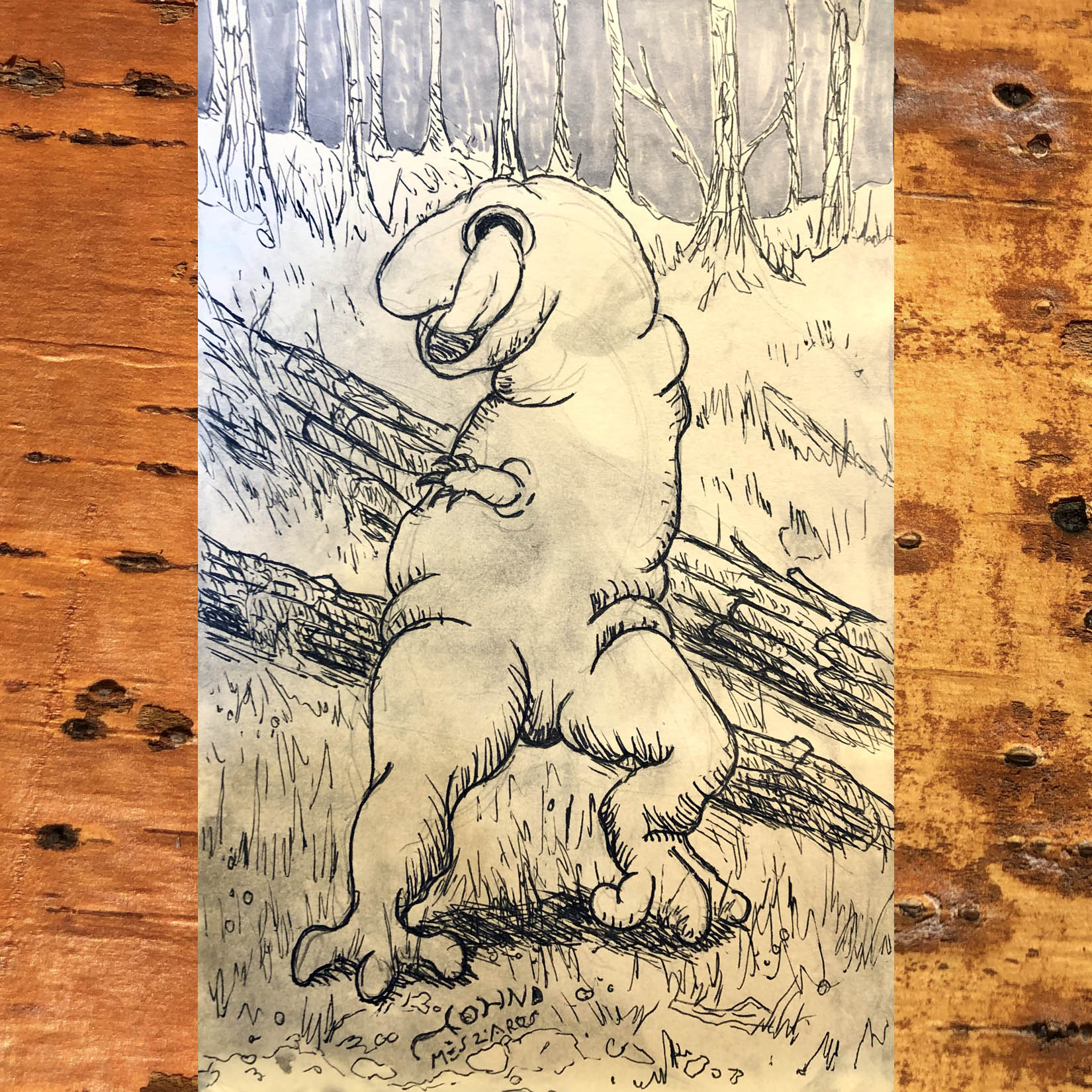
This here is the Mountain Creature Caught Running Behind a Google Car, or Mocc for short. It's recently become somewhat popular on Twitter and Reddit after a user posted a blurry photo from a Google Streetview car that appears to show an odd, bipedal creature running along a line of trees in a wooded area. Or maybe it's just a weird-looking tree stump. Either way, it's a neat new addition to American internet folklore, and has already generated a fair amount of fan art, including mine!

Friday, June 10, 2022

Pride Cryptids

It's Pride Month, so I'm reposting all my LGBTQ+ Cryptid designs!


PRIDE VAN METER VISITOR


GENDERFLUID DOVER DEMON


TRANSGENDER FRESNO NIGHTCRAWLER

                                NONBINARY CRAWFORDSVILLE MONSTER


ASEXUAL TRUNKO

I also made a couple of Pride Mothmens for this year.

    AGENDER


BISEXUAL


NONBINARY


PANSEXUAL


TRANSGENDER

All designs are available on shirts at my Teepublic store or as stickers and art at my Redbubble shop. All profits go to LGBTQ+ charities!